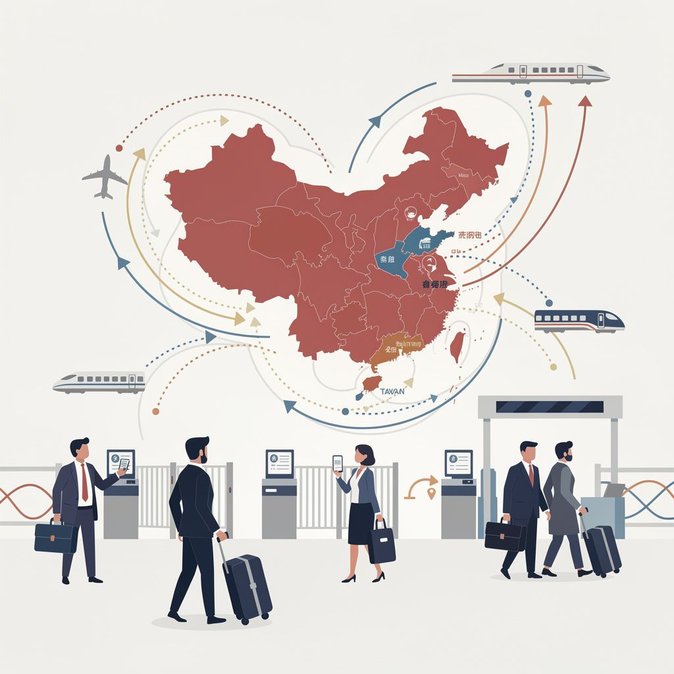
China’s National Immigration Administration (NIA) reported on 13 July that a record 369 million inbound and outbound movements were processed nationwide in the first half of 2026, a 10.8 per cent year-on-year rise. Of these, 147 million crossings were made by residents of Hong Kong, Macau and Taiwan, up 8.1 per cent.
For companies and individual travellers who need to stay on top of visa rules as cross-border traffic rebounds, VisaHQ’s Hong Kong platform provides a quick way to confirm entry requirements, file applications and monitor approvals for China and more than 200 other destinations—saving mobility teams valuable time ahead of the autumn peak.
The jump underscores how quickly cross-border mobility has normalised after the final removal of pandemic-era controls last year. Visa-free arrivals by foreign nationals grew even faster, climbing 30.6 per cent to 17.8 million, while overall foreign entries reached 45.9 million. The top sources of inbound travellers were South Korea, Russia, Malaysia, Vietnam, Thailand, Singapore, the United States, Japan, Mongolia and Australia. For Hong Kong-based multinationals, the data confirm that the flow of employees, clients and suppliers between the SAR and the mainland is firmly in recovery mode. Companies running commuter arrangements under the Individual Visit Scheme or bulk work-permit rotations should review capacity plans for the autumn peak season, when crossings traditionally spike further around National Day. The figures will also reassure firms assessing the viability of Greater Bay Area commuter programmes such as the Shenzhen–Hong Kong ‘reverse I-visa’ and Lo Wu e-Channel expansions. However, rising volumes may create congestion pressure at key land checkpoints; mobility teams should consider staggered travel times or through-train options via the Guangzhou–Shenzhen–Hong Kong Express Rail Link. Separately, transport planners note a 17.1 per cent increase in inspected vehicles (planes, trains, ships and road traffic), implying that cargo lanes are becoming busier. Logistics managers should expect tighter screening windows and build additional lead time into just-in-time supply chains.

For companies and individual travellers who need to stay on top of visa rules as cross-border traffic rebounds, VisaHQ’s Hong Kong platform provides a quick way to confirm entry requirements, file applications and monitor approvals for China and more than 200 other destinations—saving mobility teams valuable time ahead of the autumn peak.
The jump underscores how quickly cross-border mobility has normalised after the final removal of pandemic-era controls last year. Visa-free arrivals by foreign nationals grew even faster, climbing 30.6 per cent to 17.8 million, while overall foreign entries reached 45.9 million. The top sources of inbound travellers were South Korea, Russia, Malaysia, Vietnam, Thailand, Singapore, the United States, Japan, Mongolia and Australia. For Hong Kong-based multinationals, the data confirm that the flow of employees, clients and suppliers between the SAR and the mainland is firmly in recovery mode. Companies running commuter arrangements under the Individual Visit Scheme or bulk work-permit rotations should review capacity plans for the autumn peak season, when crossings traditionally spike further around National Day. The figures will also reassure firms assessing the viability of Greater Bay Area commuter programmes such as the Shenzhen–Hong Kong ‘reverse I-visa’ and Lo Wu e-Channel expansions. However, rising volumes may create congestion pressure at key land checkpoints; mobility teams should consider staggered travel times or through-train options via the Guangzhou–Shenzhen–Hong Kong Express Rail Link. Separately, transport planners note a 17.1 per cent increase in inspected vehicles (planes, trains, ships and road traffic), implying that cargo lanes are becoming busier. Logistics managers should expect tighter screening windows and build additional lead time into just-in-time supply chains.