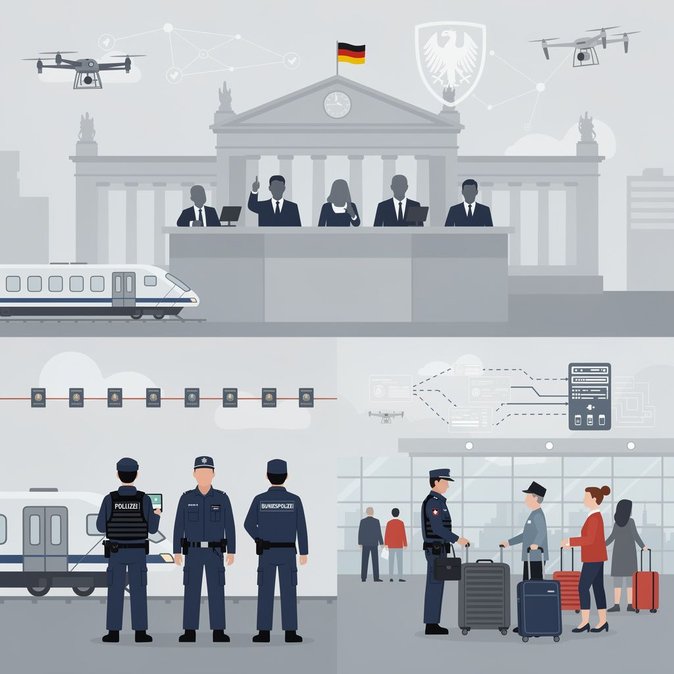
The German Bundestag has published an updated version of its long-running reform of the Federal Police Act, noting a status date of 15 July 2026. The draft law, first introduced in late-2025, has been amended in committee and is now ready for its final reading after months of expert hearings and political wrangling. Under the revised text the Bundespolizei would gain broader authority to carry out preventative “location-independent” identity checks in rail stations, airports and a 30-kilometre zone along Germany’s external EU borders. For the first time officers could also apply directly for custody orders to place irregular migrants in detention pending deportation, something that currently requires the involvement of state authorities. The Interior Ministry argues the changes are essential to combat organised migrant-smuggling networks, drone threats around airports and the rise in forged travel documents. Civil-liberty groups and parts of the governing coalition remain sceptical. Green and Left-party MPs warn that the removal of so-called “control receipts,” the limited use of body-cams and the absence of an explicit anti-profiling clause could lead to discriminatory spot-checks. Digital-rights NGOs also question the proportionality of the planned “Quellen-Telekommunikationsüberwachung” (source-telecoms surveillance) that would allow the remote infiltration of mobile devices. For employers and global mobility managers the draft has two direct implications. First, business travellers entering Germany—particularly by rail or car from neighbouring Schengen states—should expect more frequent ad-hoc border and weapons-zone checks. Employees carrying confidential data on corporate devices may also be subject to expanded forensic search powers. Second, the streamlined deportation-custody process is likely to shorten the window in which companies can regularise the status of assignees who overstay or lose their work authorisation. HR teams are therefore advised to tighten internal compliance audits and ensure that any third-country national posted to Germany always travels with proof of residence status and health insurance. The bill now returns to the plenary for its second and third readings after the summer recess. If adopted unchanged, most provisions—including the new detention rules—would take effect six months after publication in the Federal Law Gazette, giving companies only a short transition period to adapt their mobility policies.
Source: Deutscher Bundestag