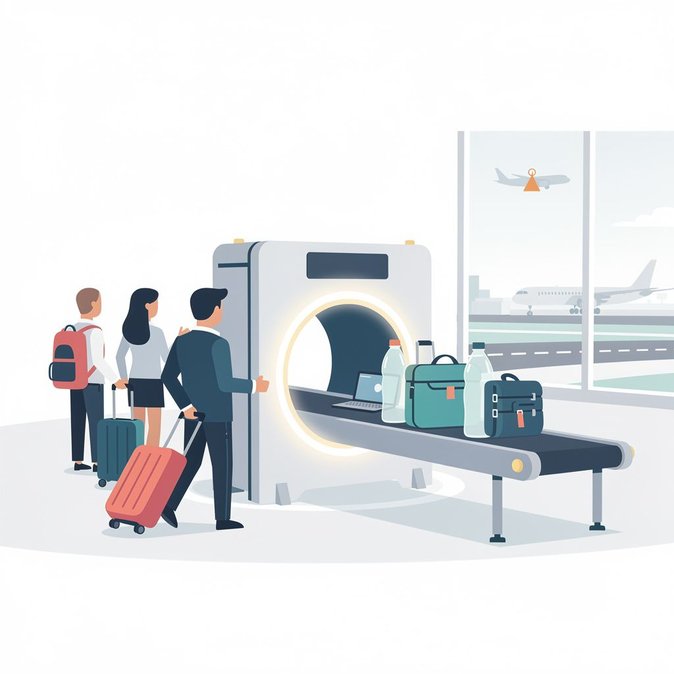
Cologne/Bonn Airport has switched on Germany’s first fully-fledged security lane system built entirely around next-generation computed-tomography (CT) scanners. The €25-million installation, inaugurated on 14 July 2026 just days before the start of the North-Rhine Westphalia school holidays, comprises eleven parallel lanes equipped with Smiths Detection Hi-Scan 6040 CTiX units and automatic tray-return belts. CT technology generates three-dimensional images of cabin baggage, allowing liquids and electronic devices to remain inside hand luggage; travellers no longer need to fumble with plastic bags or laptops, reducing average screening time per passenger by an estimated 30 percent. Federal Police and the private security provider Kötter Aviation Security say the new lanes can process up to 2 400 passengers per hour, roughly doubling the previous throughput without expanding the checkpoint’s footprint. The system also raises the liquids allowance from 100 millilitres to two litres per container, harmonising Cologne/Bonn with the UK and the Netherlands where similar equipment is already standard. A dedicated “Kids Lane” with lower roller conveyors and colourful signage was added to help families move faster through the checkpoint. For Germany’s business-travel market the upgrade arrives at a critical moment. The Cologne region is a major trade-fair hub and low-cost carrier base; operators such as Eurowings had warned that punctuality targets for the summer schedule would be jeopardised without faster screening. With Berlin, Hamburg, Munich and Frankfurt all planning CT roll-outs in 2027, Cologne/Bonn will serve as a live test bed for staffing models and data-sharing between federal police and airport operators. The project underlines Berlin’s broader push to modernise border-control infrastructure ahead of the EU Entry/Exit System (EES) expansion. Lessons learned in Cologne will feed into the “One-Stop-Security” concept, which envisages accepting security screening from the point of origin for connecting passengers inside the Schengen Area. If proven successful, the blueprint could eventually cut repeated checks for domestic transfers at hubs such as Frankfurt and Munich, saving airlines millions in delay costs. Travel-management companies advise corporate flyers to update internal travel policies immediately: employees departing Cologne/Bonn can leave laptops, power banks and toiletries inside their bags, but should still keep liquids easily identifiable in case of manual inspection. Airlines are also reminding passengers that while the airport now accepts up to two-litre containers, the final destination’s rules continue to apply on the return leg.
Source: DIE ZEIT / dpa