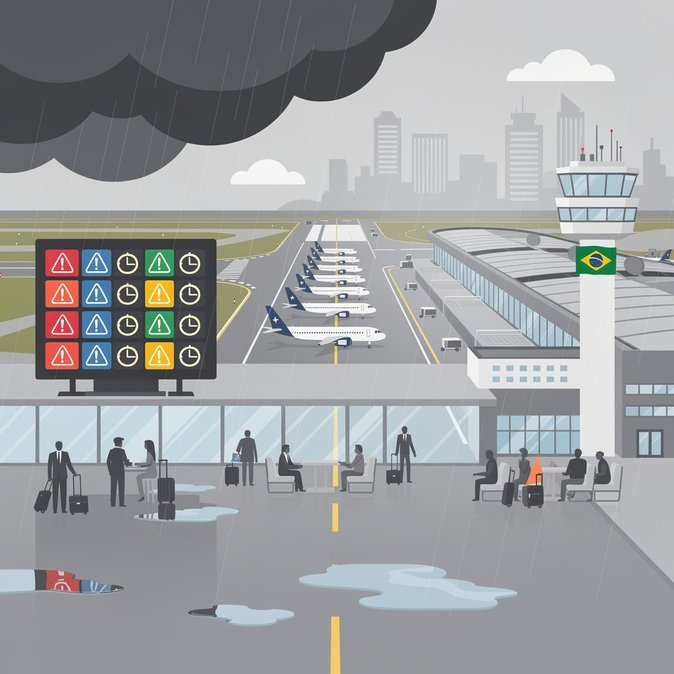
Travellers moving through Brazil’s busiest air-traffic corridor faced an unexpectedly rough start to the winter holiday rush on 16–17 July, when cascading operational problems triggered 204 delays and 45 outright cancellations across São Paulo, Rio de Janeiro and four other hub airports. Real-time data compiled by independent tracker FlightAware and reported by Nomad Lawyer show that São Paulo-Guarulhos (GRU) alone registered 113 delayed rotations, while its downtown counterpart Congonhas (CGH) cancelled 15 high-frequency shuttle flights. Airlines felt the squeeze unevenly. LATAM Brasil absorbed the biggest absolute hit, chalking up 76 delays and 11 cancellations—roughly 9 % of its daily programme—followed by GOL (57 delays/9 cancellations) and Azul (47 delays, but no cancellations). Smaller feeder subsidiary Azul Conecta saw a 10 % cancellation rate as tight crew rotations and a limited spare-aircraft pool left little slack. Industry sources blame a perfect storm of winter weather deviations over the Southeast, runway-capacity constraints at GRU and union-negotiated crew-duty timeouts that converged late on Thursday evening and rippled through Friday morning’s departure banks. For corporate mobility managers the disruption is a timely reminder that Brazil’s hub-and-spoke network remains highly centralised. An incident at GRU quickly spills into secondary cities such as Belo Horizonte, Curitiba and Vitória, increasing the likelihood of missed connections for expatriates and short-cycle business travellers. Under ANAC Resolution 400, carriers must provide meals after two-hour waits, hotel accommodation after four, and allow free re-routing—including on competing airlines—once delays exceed that threshold. Companies with large travelling populations should ensure travellers keep digital boarding passes and obtain written delay statements at the gate; these documents are mandatory for later compensation claims. Looking ahead, ANAC inspectors told local press they will open a fact-finding review next week to determine whether airlines scheduled “over-optimistic” turnaround times during the peak fortnight. If systemic flaws are proven, fines can reach BRL 200,000 per occurrence—costs that ultimately trickle down to ticket prices and corporate travel budgets. In the meantime, experts recommend building an additional three-hour connection buffer at GRU and CGH for at least the next ten days as airlines work to reposition aircraft and crews. Brazil’s air passenger market has rebounded to 140 million annual trips—roughly 93 % of pre-pandemic volume—which means even minor operational shocks can snowball quickly. Until structural capacity at São Paulo’s gateways is expanded, travel managers may wish to route time-sensitive itineraries through Brasília or Recife, which showed normal operations during the disruption window.
Source: Nomad Lawyer