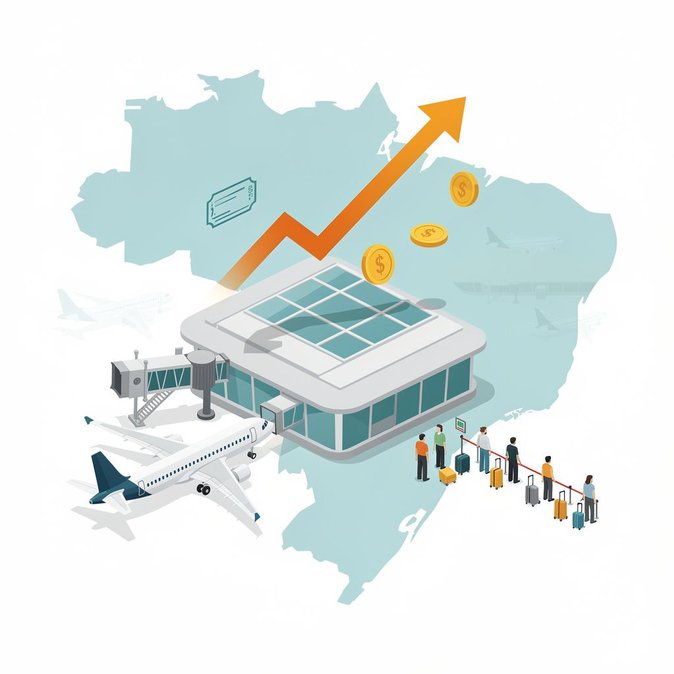
Brazilian business travelers will soon pay more to board flights at the country’s busiest hubs. On 13 July the National Civil Aviation Agency (ANAC) published a new ordinance in the Diário Oficial da União raising the maximum ceilings for embarkation, connection, landing, parking, warehousing and cargo-handling fees at 14 airports, including the international gateways of São Paulo/Guarulhos and Campinas/Viracopos. The concessionaires that manage these airports have 30 days to update their price tables, meaning the higher charges should reach tickets issued from mid-August onward. At Guarulhos the domestic boarding fee will rise from R$ 33.64 to R$ 35.75, while the international fee jumps from R$ 59.54 to R$ 68.61. At Viracopos the ceilings move from R$ 30.32 to R$ 33.44 (domestic) and from R$ 53.64 to R$ 59.17 (international). Similar percentage increases—6.3 % at GRU and 4.7 % at VCP—apply to aircraft-related charges, allowing operators to pass part of their higher cost base on to airlines. Twelve regional airports that form part of the Guarulhos concession via the AmpliAR programme also had their caps adjusted. According to ANAC, the readjustment follows the contractual inflation formula designed to preserve the economic balance of long-term concessions signed a decade ago. Because boarding fees are mandatory and embedded in ticket prices, the impact will be felt most on low-fare promotional tickets where the fixed tax represents a larger share of the final price. Financial-planning consultant Cecílio Costa notes that a R$ 30 boarding fee accounts for 20 % of a R$ 150 promotional fare but less than 3 % of a R$ 1,200 business-class ticket. Corporations with travel-intensive operations therefore need to revise their 2026 budgets for domestic shuttles and international rotations originating at the affected terminals. Airlines, already thinly capitalised, face an incremental uptick in operating expenses at a time when the real has weakened against the dollar and jet-fuel prices remain volatile. While carriers may try to absorb part of the hike to stay competitive, analysts expect at least partial fare transmission during Brazil’s September–October business-travel peak. Travel managers are advised to lock in Q3 tickets early and to monitor airport choice for connecting itineraries—especially when alternative hubs such as Belo Horizonte (CNF) or Rio Galeão (GIG) remain temporarily unaffected. In the medium term, the tariff increase shores up revenue streams that concessionaires intend to reinvest in capacity, self-service biometrics and sustainability upgrades mandated by ANAC’s new environmental governance framework. For multinational companies that use Brazil as a South American hub, the measure underscores the importance of factoring regulatory risk into long-range mobility cost projections.
Source: Exame