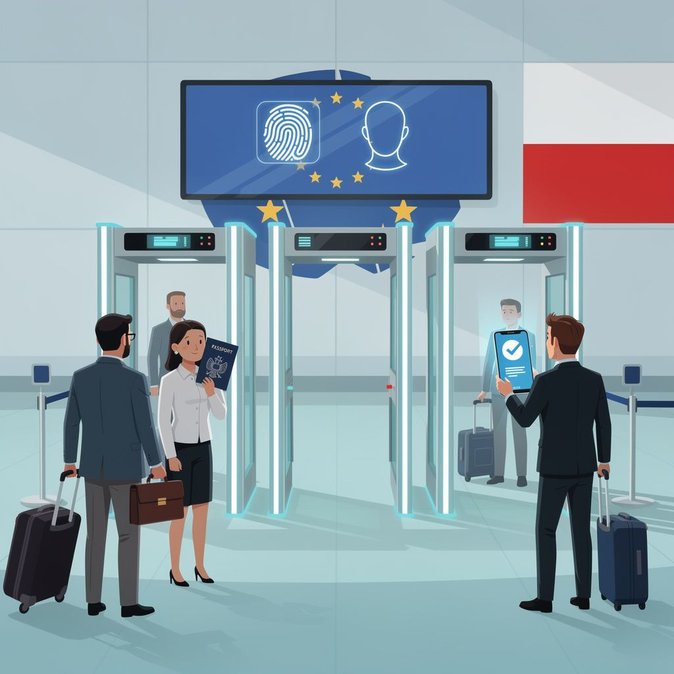
Business visitors, tourists and other non-EU nationals planning trips to Poland will soon face a very different border experience. A research briefing issued on 17 July 2026 by the UK House of Commons Library explains that the European Union’s long-delayed Entry/Exit System (EES) is now in its final phase-in period and will become fully operational at all external Schengen borders by October. EES replaces manual passport stamping with an automated register that captures fingerprints, a facial image, passport data and exact time and place of entry and exit. The system already functions at many Polish airports and highway crossings and will expand to every point of entry during the summer. For Poland, which shares busy external borders with Ukraine, Belarus and Russia and operates several major international airports, the technology is expected to speed legitimate flows while giving the Straż Graniczna (Border Guard) faster alerts on travellers who overstay or attempt multiple illegal entries. The briefing notes that travellers exempt from Schengen visas—such as UK, US and Canadian passport-holders—will have their biometrics recorded the first time they enter and then verified on subsequent trips. Long queues were reported during trial runs last year, but Warsaw Airport has since installed additional self-service kiosks and deployed multilingual staff to assist corporate groups. Closely linked to EES is the European Travel Information and Authorisation System (ETIAS). From late 2026, visa-exempt visitors will have to obtain an online authorisation, currently priced at €20, before boarding transport to Poland. ETIAS checks security and health databases and is valid for multiple short-stay visits over three years. Companies sending employees for meetings or trade fairs should build the short application process into their travel timelines; carriers will deny boarding to passengers who lack a valid ETIAS or Schengen visa once the scheme is live. Polish authorities welcome the new tools, arguing they will ease pressure on land borders that have seen record irregular-migration attempts since 2025. The Ministry of the Interior says that automated gates and pre-travel vetting will let officers focus on high-risk cases while legitimate passengers clear the frontier in under a minute. Travel associations, however, urge continued contingency planning: staffing, training and public-information campaigns will determine whether the autumn rollout proceeds smoothly or repeats last year’s bottlenecks. Practical implications for employers are clear. HR and mobility teams should update travel policies, brief staff on biometric capture (including privacy aspects) and confirm that third-country contractors, clients and event attendees understand ETIAS rules. Frequent travellers whose fingerprints are hard to capture (for example, some manual-labour workers) are advised to allow extra time at first entry. As Poland prepares to host major conferences in the fourth quarter, early compliance will be essential to keep business trips on schedule.
Source: House of Commons Library