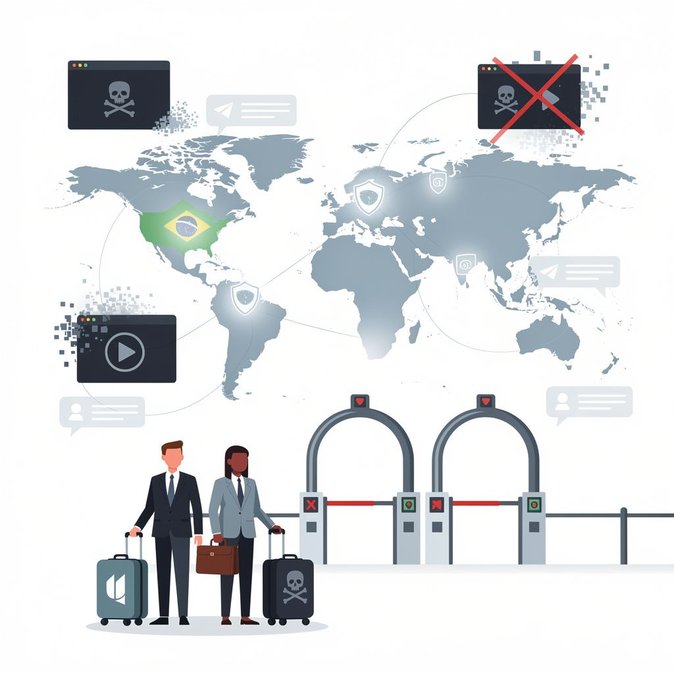
On 20 July the Ministry of Justice and Public Security confirmed Brazil’s participation in “Operação Cartão Vermelho,” a coordinated enforcement sweep led by the U.S. Department of Justice and Homeland Security Investigations targeting World Cup 2026 piracy. Authorities in Argentina, Brazil, Chile, Colombia, Dominican Republic, Ecuador, Paraguay, Peru and the United States simultaneously took down 309 domains and 109 IP addresses in Brazil alone that were illegally streaming matches. Brazilian cyber-crime unit Ciberlab also worked with Telegram to delete 348 channels with more than 1.5 million subscribers. The operation is part of a wider push to protect broadcasting rights and official merchandise revenues estimated at US$1 billion across Latin America. For cross-border travellers the immediate impact is limited, but the action underscores heightened scrutiny at Brazilian ports and airports. Customs officers will be equipped with new handheld scanners capable of authenticating World Cup holograms on jerseys and souvenirs. Travel managers bringing corporate hospitality guests to São Paulo and Rio for knock-out matches should warn invitees that even small quantities of counterfeit gear can trigger fines and seizure. The crackdown also signals deeper data-sharing between enforcement agencies, potentially accelerating future cooperation on immigration fraud and human-trafficking investigations. Analysts note that Ciberlab’s domain-blocking technology is the same stack being integrated into the upcoming MigranteWeb platform, suggesting a gradual convergence of cyber and border-security capabilities.