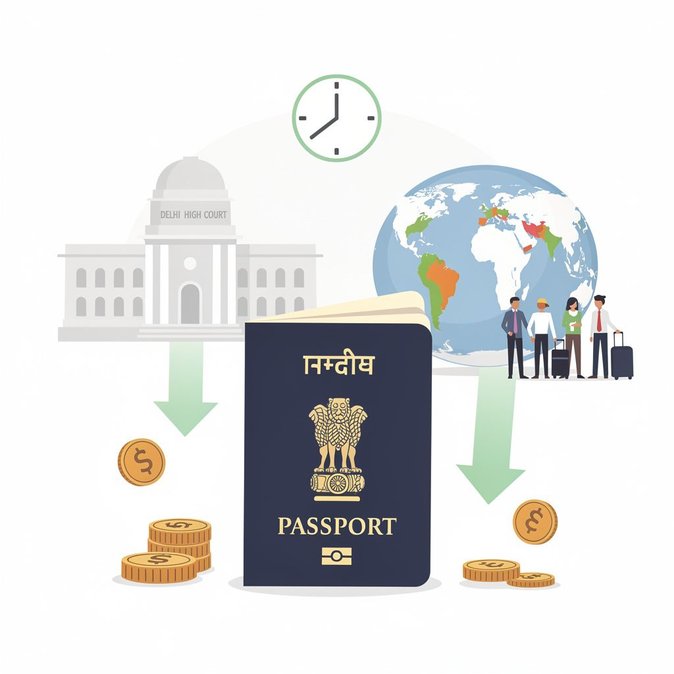
In a decision that could ease the cost of global mobility for millions of Overseas Indians, the Delhi High Court on 22 July 2026 directed the Union Ministry of External Affairs (MEA) to decide within three months on a public-interest petition challenging the sharp passport-fee increases that took effect on 1 July. The new Passports (Amendment) Rules 2026 raised the standard 36-page passport fee for residents from ₹1,500 to ₹2,500, but hiked the fee for non-resident Indians (NRIs) from US $75 (≈₹7,165) to US $125 (≈₹11,942)—a nearly 67 per cent jump. Petitioners Pravasi Legal Cell argued that the differential pricing violates Articles 14 and 21 of the Constitution and disproportionately burdens blue-collar workers in the Gulf who must renew passports every five years to keep jobs and residence visas. Chief Justice D. K. Upadhyaya and Justice Tejas Karia treated the plea as a representation, instructing the MEA to review the policy on its merits and communicate a reasoned decision to stakeholders. While the court stopped short of a stay, the tight three-month window signals pressure on the government to justify or roll back the surcharge on overseas applicants. For corporate mobility programmes the ruling is significant. Bulk passport renewals for offshore staff—especially in the UAE, Saudi Arabia and Singapore—now cost employers roughly ₹4,800 more per employee when agency fees and courier charges are included. A reversal would save large construction and IT firms tens of millions of rupees annually and remove a budgeting uncertainty in assignment cost projections. Until the MEA issues its response, travel managers should continue paying the higher fee but build a credit-note mechanism to recuperate any overpayments if the rules are amended. Companies may also consider staggering renewals for employees whose passports expire in 2027-28 to await clarity.
Source: LiveLaw