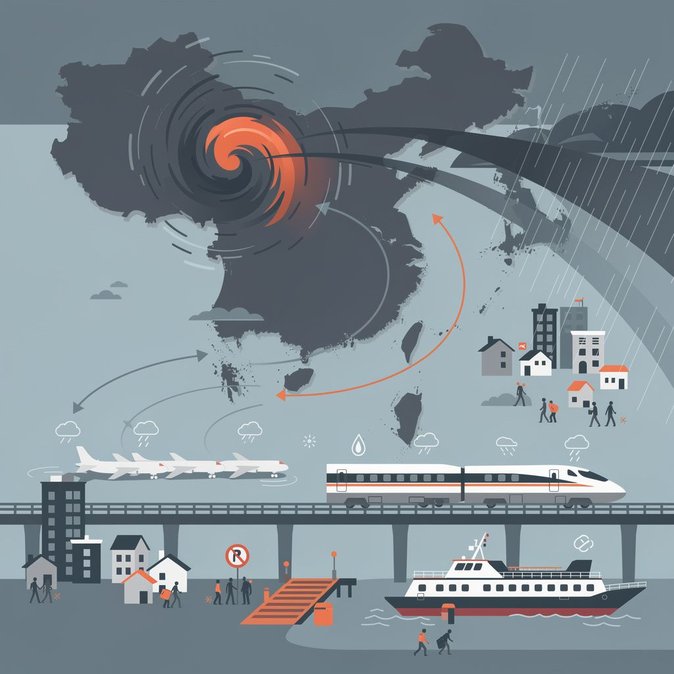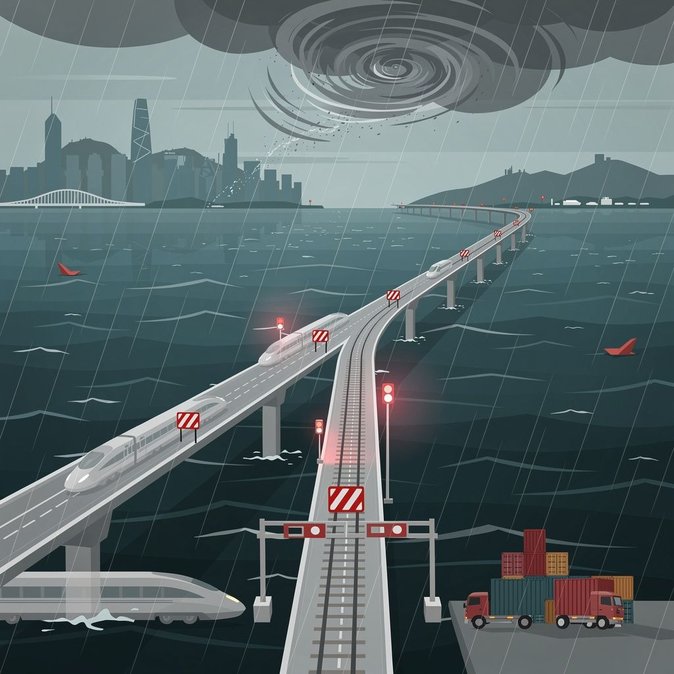
The Hong Kong Transport Department (TD) issued a city-wide travel bulletin at 02:00 on 26 July after upgrading the Tropical Cyclone Warning to Signal No. 9. The notice ordered the closure of the Hong Kong–Zhuhai–Macao Bridge Hong Kong Link Road, the Shenzhen Bay Bridge (mainland-bound), and the cycle track on the Cross-Bay Bridge. All franchised bus routes and every passenger-ferry service were suspended; the Lok Ma Chau–Huanggang shuttle reduced operations to an hourly skeleton run. High-speed rail was also hit. While the East Rail Line continued local service, China State Railway cancelled more than 90 cross-boundary G-series trains for 25–27 July, including Beijing–Hong Kong and Shanghai–Hong Kong pairs. The TD published an extensive list of cancellations and replacement services and urged passengers to process refunds through the 12306 app within 30 days. Motoring across the boundary was impossible overnight as the HZMB Main Bridge lowered its speed limit to 50 km/h and then closed entirely to double-deck buses and heavy goods vehicles. The shutdown stranded dozens of foreign executives returning from Zhuhai’s semiconductor exhibition, many of whom were forced to wait out the storm in Macao. Inbound corporate groups already in Hong Kong faced limited hotel availability because the city’s ‘Extreme Conditions’ declaration prevents outdoor work, including housekeeping, until a first inspection of wind damage can be completed. Several global relocation firms told clients to expect at least two-day delays in household-goods deliveries scheduled via HZMB trucking lanes. Practical steps for HR: 1) advise employees not to attempt land border crossings until the TD confirms bridge inspections are complete; 2) re-book cancelled West Kowloon HSR tickets as soon as the 12306 system retags inventory; and 3) monitor bus-company apps, which will push live resumption times once Signal No. 8 is lifted.
Source: Hong Kong Transport Department