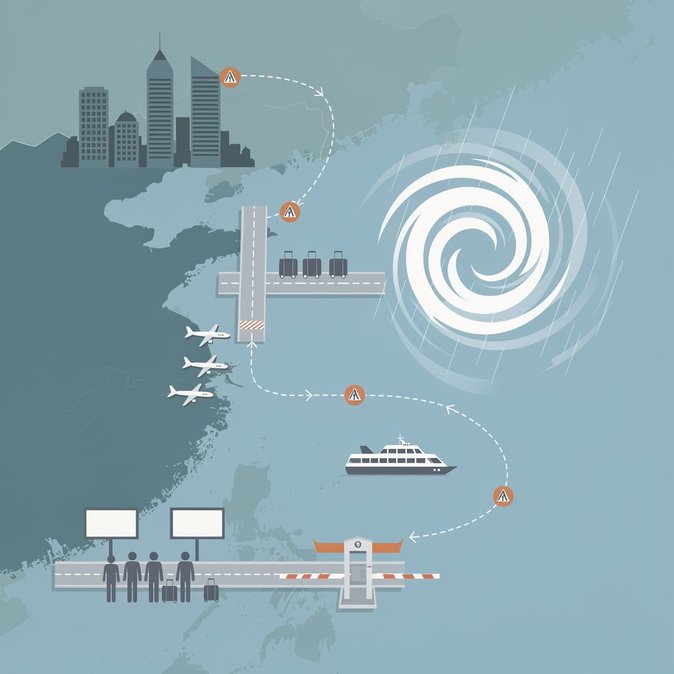
China’s Ministry of Emergency Management said on Sunday that more than 801,000 residents had been relocated across Guangdong as Typhoon Noul, the strongest storm to reach the country this year, slammed ashore near Huidong County at 3:50 a.m. The Associated Press reported that the Ministry of Water Resources upgraded its flood-control response to Level II, with mountain-flood alerts in 37 river basins. Railway authorities pre-emptively shut down coastal high-speed services between Guangzhou, Shantou, Xiamen and Fuzhou, while China State Railway Group froze ticket sales on the busy Beijing–Guangzhou and Shanghai–Kunming lines for trains transiting the Pearl River Delta. The National Development and Reform Commission released ¥100 million (US$14.8 million) in emergency funds for infrastructure repairs. Guangdong’s Department of Transportation barred high-sided vehicles from expressways in eight cities, and ports in Shenzhen, Zhuhai and Shantou suspended container loading. Multinational manufacturers from Apple suppliers in Dongguan to auto plants in Guangzhou South Economic Zone invoked typhoon clauses to halt production shifts, potentially delaying just-in-time components headed for global assembly lines. International insurance brokers Marsh and Aon said early estimates place insured losses at US$450-600 million, excluding business-interruption claims that could rise if port closures extend beyond 48 hours. Supply-chain risk analysts advised companies to activate dual-sourcing agreements for electronics and apparel components normally shipped through Shenzhen’s Yantian and Chiwan terminals. Although Noul weakened to a tropical storm by late afternoon, authorities warned that residual rainfall could trigger landslides in northern Guangdong and neighbouring Jiangxi and Hunan, where flood defences are already saturated from recent storms.
Source: Associated Press