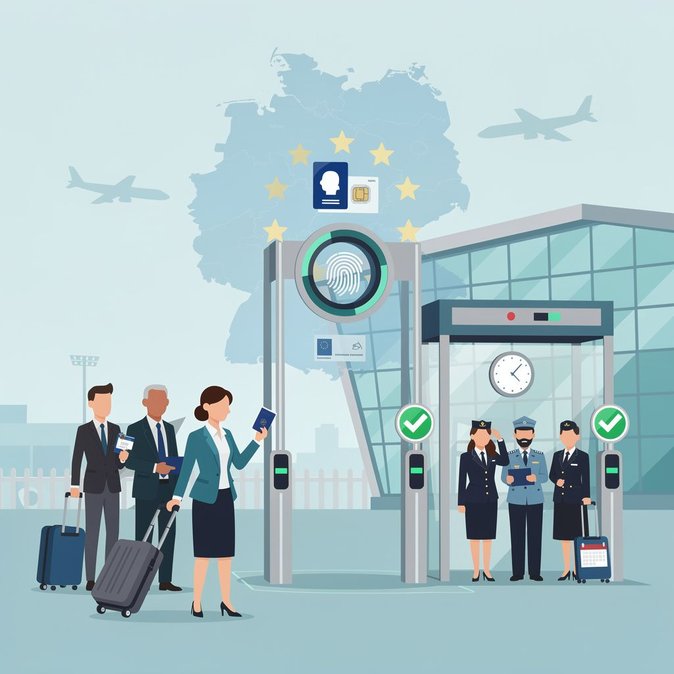
The European Commission’s Directorate-General for Migration and Home Affairs has issued an updated guidance note outlining who is exempt from the new Schengen Entry/Exit System (EES), which has been fully operational at all external borders since 10 April 2026. The clarification, published on 27 July 2026, comes just as German airports brace for the height of the summer season, when passenger volumes traditionally surge. Under the biometric EES, the traditional passport stamp has been replaced by a digital record that stores travellers’ facial image, fingerprints, passport data, and the exact time and place of every crossing. The system applies to all non-EU nationals entering the Schengen Area for short stays, including business travellers and posted workers, but the Commission stresses that a range of persons remain exempt. These include accredited diplomats, heads of state and government, crew of ships and aircraft who stay on board, and holders of local border-traffic permits. The guidance also explains how data for frequent cross-border workers and truck drivers is handled to minimise wait-times. For German companies the stakes are high. Frankfurt, Munich and Düsseldorf all handle significant volumes of inter-continental business traffic; any mis-categorisation of travellers could lead to delayed meetings, missed connections and additional compliance headaches. Airport operators have therefore stepped-up staff briefings, while the Federal Police (Bundespolizei) has issued a German-language handbook that mirrors Brussels’ exemption list to ensure consistent frontline decisions. Large employers such as Siemens and BASF have begun circulating the new rules to their mobile workforces, warning that carrying evidence of exemption status—diplomatic passport, crew manifest or APEC Business Travel Card—will be essential. Germany’s travel-tech sector is also responding. Several duty-of-care platforms are integrating an “EES eligibility widget” that prompts travellers to upload supporting documents before departure. Travel-management companies (TMCs) report a 40 % increase in corporate enquiries over the past week, mainly from US and UK subsidiaries whose employees fear being caught in the wrong queue. Lufthansa says it will trial a dedicated EES support desk in its Senator lounges from 1 August. Although the Commission dismissed calls for a blanket suspension of the new border checks, it acknowledged “around 20 difficult spots” across the Schengen zone where bottlenecks persist. German industry associations are pressing the Federal Interior Ministry to publish real-time wait-time data so that businesses can adjust itineraries proactively. For now, the best advice for corporate travellers remains simple: check whether you qualify for an exemption, carry proof, and build in extra time for every German border crossing this summer.