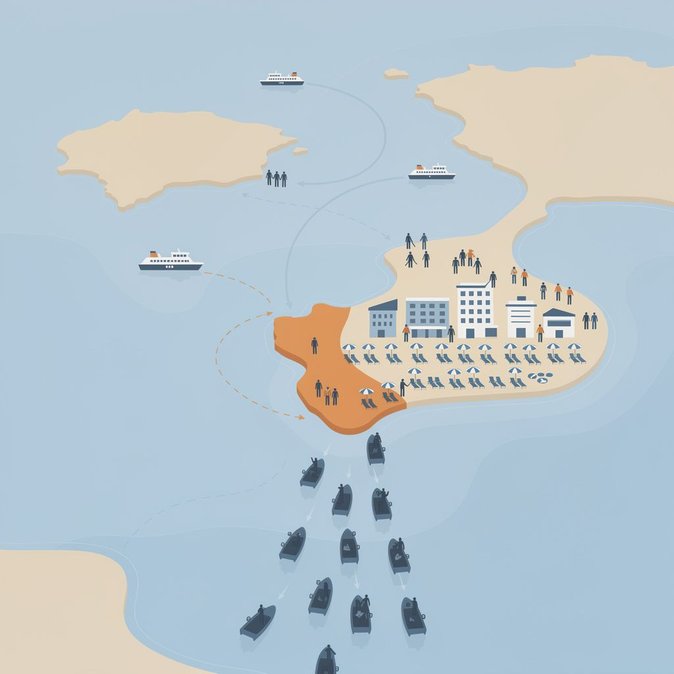
At a press briefing on 28 July, the Balearic Islands’ vice-president Antònia Maria Estarellas revealed that 11,055 migrants have arrived in the archipelago by small boat since 1 January 2025—and that 51 % of them disembarked on the tiny island of Formentera. The figures, compiled by the regional interior ministry, show a continued shift of the Algeria-to-Balearics route away from Mallorca and towards the more weakly policed southern coastline of Formentera. Local authorities accuse Madrid of under-funding reception facilities. The Balearic government says it has spent €34 million this year on emergency accommodation and medical care, yet received only €2 million in extraordinary state transfers. Estarellas warned that tourist infrastructure—including hotels quietly contracted for migrant housing—could come under further strain during the August high-season, when boat traffic typically peaks. For businesses operating in hospitality and yachting, the spike in irregular landings raises both reputational and operational issues. Hotel managers report short-notice requisitions of vacant rooms by social services, while ferry operators fear stricter maritime surveillance zones could disrupt commercial schedules. Insurers are already updating travel-risk advisories for corporate clients sending staff to the islands. On the national stage, the numbers give fresh urgency to Spain’s implementation of the EU Pact on Migration and Asylum, which entered force last month. Under the pact’s solidarity mechanism, other autonomous communities may be asked to relocate some of the Balearic caseload—an option welcomed by local officials but likely to meet political resistance elsewhere. The Interior Ministry has not yet commented on the figures but has previously argued that overall irregular arrivals to Spain are down 25 % year-on-year. Balearic leaders counter that regional spikes require targeted resources, not averages, and have requested a joint task-force with Frontex to patrol the Ibiza Channel.
Source: Cadena SER – Radio Ibiza