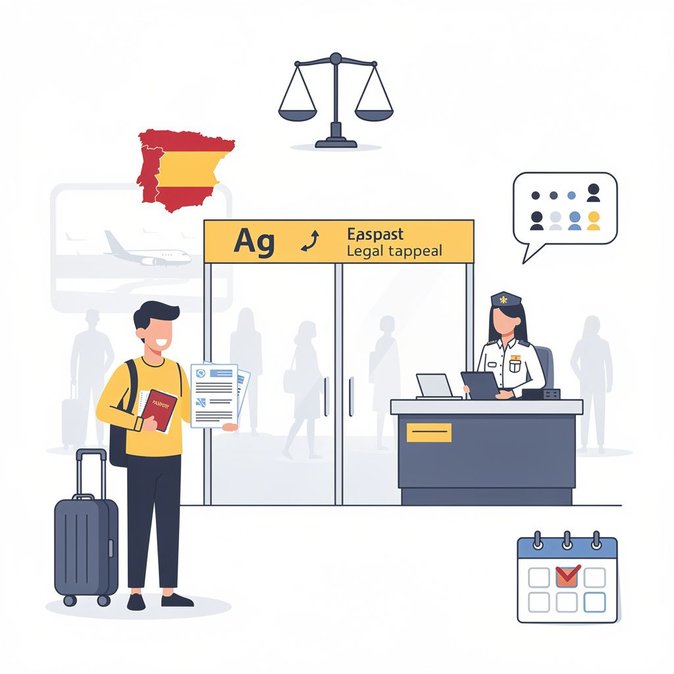
On 28 July Spain’s National Police quietly updated the guidance page that officers use when refusing a foreign national at the frontier. The revised text clarifies travellers’ rights to legal counsel, translation and appeal, and spells out the timeline (72 hours) for filing a contentious-administrative review. While the document is primarily aimed at border officers, it also serves as a public notice because it is hosted on the police’s citizen portal. The timing is significant: refusals of entry have risen 18 % since the Entry/Exit System pilot began in April, according to internal figures leaked to the press last week. Most cases involve passengers who failed to prove financial means or whose return ticket exceeded the 90-day Schengen limit. The clearer instructions are intended to reduce on-the-spot disputes that have been clogging secondary inspection rooms at Madrid-Barajas, Málaga-Costa del Sol and the land border at La Linea (Gibraltar). For companies flying in non-EU staff for meetings or short projects, the update is a reminder to prepare supporting documents—hotel bookings, invitation letters, and proof of onward travel—in Spanish as well as English. Immigration lawyers note that the new text explicitly mentions the right to request an ‘abbreviated motivation’ in English or French, which can speed up re-applications at another Schengen port. The guidance also instructs officers to offer rejected travellers information on free legal aid if they lack resources—an obligation long present in the law but rarely enforced. Carriers must now keep copies of the refusal form (Modelo S-4) for two years instead of six months, aligning aviation and maritime operators with the record-keeping rules already applied to international coach companies. Although the notice does not constitute a legal change—the underlying Foreigners’ Law remains the same—it operationalises Spain’s commitments under the EU Returns Directive and anticipates case-law from the Court of Justice of the EU expected later this year on effective remedies at the border.