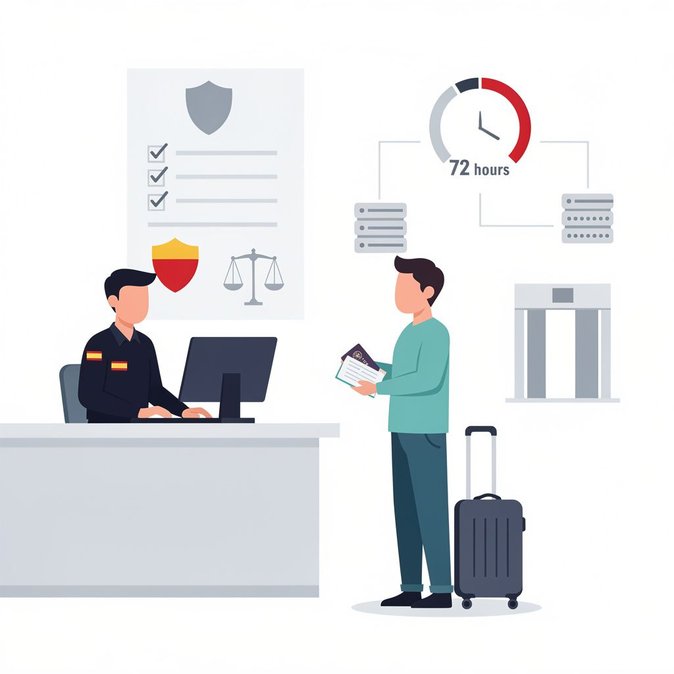
Spain’s National Police Directorate (Dirección General de la Policía) quietly posted a completely revised notice on 28 July 2026 that rewrites the steps officers must follow when they deny entry to a foreign national at airports, seaports or land crossings. Although refusal-of-entry is regulated by Organic Law 4/2000 and the Schengen Borders Code, operating instructions had not been updated since before the EU’s new Entry/Exit System (EES) went live in April. The new guidance clarifies that travellers who fail to meet visa, financial-means or security requirements will now receive a written decision that lists—in their own language where possible—the legal basis for the refusal, the appeals process, and their right to free legal assistance and an interpreter. Border officers must stamp the traveller’s passport with an indelible black cross and arrange the person’s stay in a dedicated holding area until the earliest outbound connection. Where removal cannot be completed within 72 hours, the officer must immediately seek judicial authorisation for temporary detention in non-penitentiary facilities that provide social, legal and medical support. A notable change is the mandatory notification to both Spain’s Ministry of Foreign Affairs and the traveller’s embassy or consulate whenever detention is required, a measure aimed at improving consular access and reducing lawsuits over due-process violations. The instruction also references Royal Decree 1155/2024—which entered into force this year—aligning time-limits and appeal avenues with Spain’s new immigration regulations. For corporate mobility teams the update is a reminder to double-check that visiting staff carry proof of accommodation, return tickets and funds (currently €121.10 per person per day) when entering Spain. Failure to prepare may now trigger a quicker—and more thoroughly documented—refusal, potentially complicating future Schengen travel because every refusal is automatically uploaded to the shared EES database. HR managers should brief travellers, especially short-term contractors and event attendees, on the stricter frontline checks and ensure 24/7 legal-assistance contacts are in place in case of emergency.