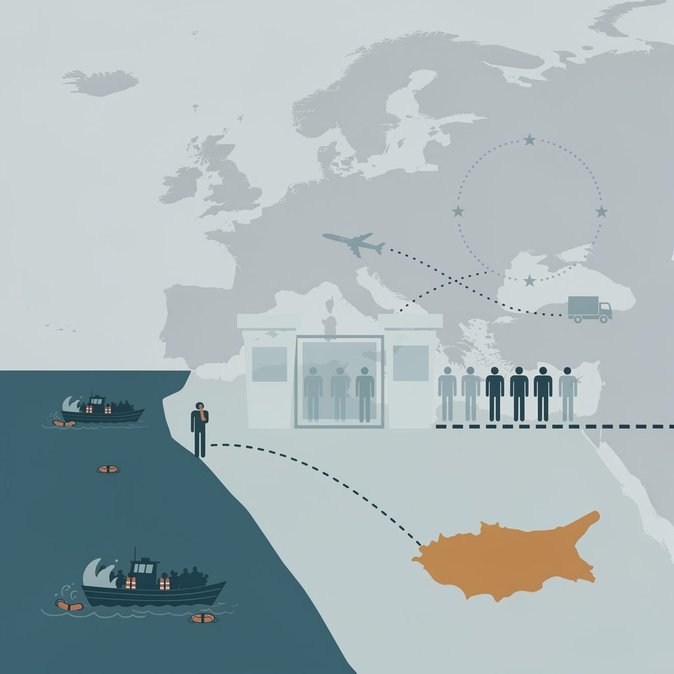
Cyprus has aligned itself with a group of 18 EU member states that are demanding an urgent videoconference of interior ministers following last night’s mass attempt by an estimated 50,000–60,000 migrants to storm Spain’s north-African enclave of Ceuta, which left at least 67 people dead. The joint letter—signed by Nicosia alongside Italy, Denmark, Austria and 14 others—warns that uncontrolled crossings and the “instrumentalisation of migration” threaten confidence in the EU’s common border and asylum rules. Cypriot officials told the Cyprus News Agency that the island, already grappling with the highest per-capita asylum-application rate in the bloc, “cannot afford further erosion of Schengen discipline” as it prepares for its own long-delayed accession to the passport-free area later this year. The episode has sharpened debate in Cyprus over external-border resilience. Interior-ministerial sources said the government will use the extraordinary meeting to push for a Schengen-wide contingency mechanism that allows rapid redeployment of Frontex personnel to pressure points—including the island’s Green Line, which is not an external EU frontier but has become a route for irregular entry from the Turkish-controlled north. Business associations welcomed the Cypriot signature, arguing that another Schengen shock—such as Italy’s threat to re-impose controls on arrivals from Spain—would disrupt supply chains and corporate mobility across the single market. Employers’ federation OEB noted that 70 % of foreign executives posted to Cyprus travel frequently within the EU and rely on predictable, control-free borders. For global-mobility managers, the immediate impact is confined to possible flight-schedule tweaks for staff transiting Spain’s airspace, but the longer-term stakes are higher. If the Ceuta tragedy triggers tighter admissibility screening or prolonged internal controls, Cypriot firms face higher compliance costs and uncertainty just months before the island hopes to secure a positive Council vote on Schengen entry. Experts therefore advise companies with regional hubs in Nicosia, Limassol or Larnaca to review multi-jurisdictional travel policies, ensure posted-worker notifications are up to date, and monitor forthcoming JHA Council announcements closely.
Source: Associated Press