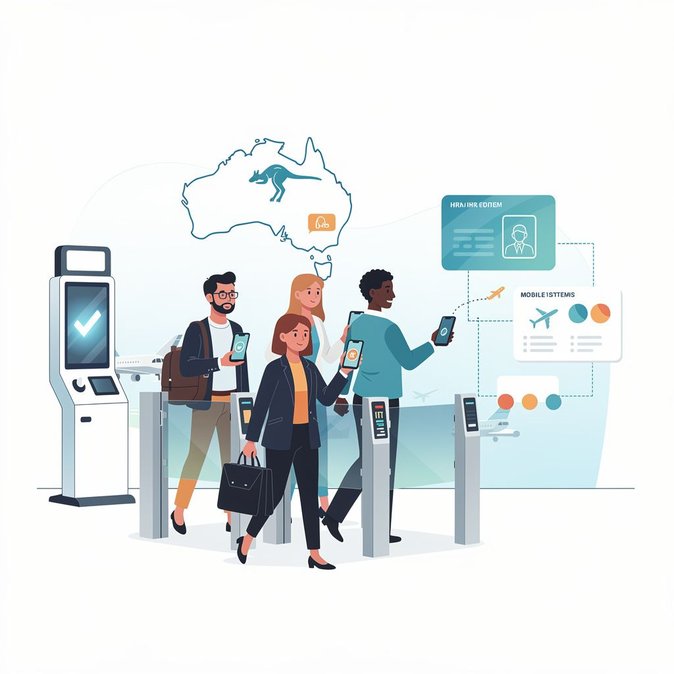
Australia’s Data and Digital Ministers have released a national *Digital ID and Verifiable Credentials Strategy* that sets a 2027 target for “digital-only” proof-of-identity across government and industry services, including international travel. The strategy, endorsed on 21 September 2026 by Commonwealth, state and territory ministers, commits jurisdictions to mutual recognition of government-issued digital IDs and to open standards that allow passports, visas and driver licences to be stored as verifiable credentials in travellers’ mobile wallets. Although framed as a whole-of-economy reform, the document has immediate implications for global mobility managers. Home Affairs is already piloting a fully digital Australia Travel Declaration (ATD) and has signalled that digital IDs will plug directly into SmartGate kiosks, reducing arrival processing to “a few seconds”. Border Force says the move could eliminate manual sighting of visa labels and incoming passenger cards within three years, cutting airport dwell-time for frequent business travellers. Corporate travel suppliers welcome the plan but caution that interoperability with other countries’ systems is critical. Australia plans to align with the International Civil Aviation Organization’s Digital Travel Credentials (DTC) framework, which Singapore, the Netherlands and Canada are also trialling. Employers should begin testing mobile wallet solutions that can hold verifiable credentials issued by multiple authorities to ensure staff can board flights and pass immigration even if physical documents are misplaced. Privacy groups note the Strategy’s commitment to “minimal disclosure”—only confirming attributes needed for a transaction—but have called for stronger safeguards before biometric and credential data are shared internationally. The government says the Australian Competition and Consumer Commission will regulate accreditation while the Office of the Australian Information Commissioner oversees privacy compliance. For multinationals operating in Australia the next step is to map how digital IDs will interact with right-to-work checks. Once verifiable work visas are live, employers will be able to scan a QR-style code and receive real-time confirmation from Home Affairs, reducing the administrative burden of VEVO searches. Mobility teams should engage with HR-tech suppliers now to integrate credential-validation APIs ahead of the 2027 deadline.
Source: Department of Finance
How VisaHQ can help
VisaHQ simplifies the visa application process for individuals and businesses. Check current travel requirements, prepare the required documents and manage your application online through the VisaHQ Australia portal.More From Australia
View all
Four Chinese Travellers Lose Visas after $250k Illicit-Tobacco Bust at Melbourne Airport

Daily Migration Update: New Processing Directions Now Operational; Subclass 189 Invitation Round Expected by 30 September