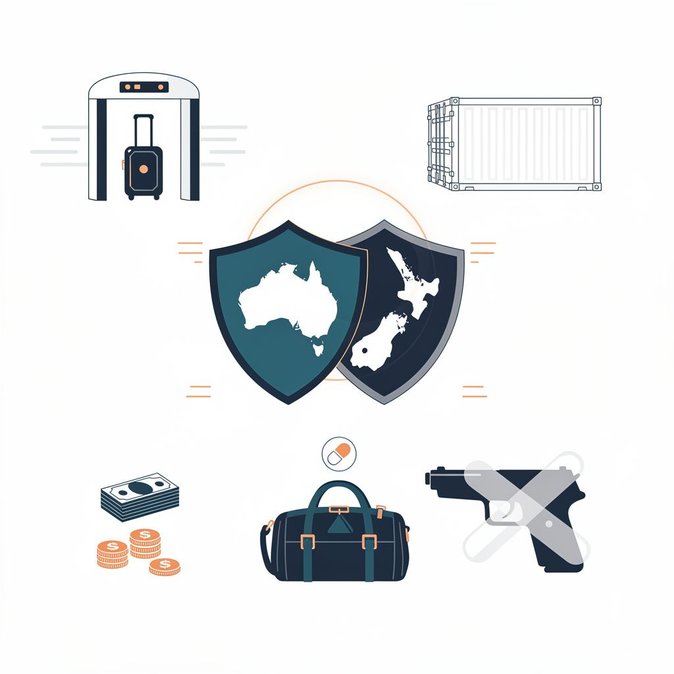
A joint week-long enforcement surge has delivered one of the biggest coordinated border-security crack-downs Australia and New Zealand have ever run. Law-enforcement agencies on both sides of the Tasman—every state and territory police service, the Australian Federal Police, Australian Border Force (ABF), the Australian Criminal Intelligence Commission, AUSTRAC, the Department of Home Affairs, New Zealand Police and New Zealand Customs—mounted simultaneous operations between 14-18 September that culminated in today’s announcement of 1,203 arrests and 3,339 separate charges. Authorities also seized 1.3 tonnes of illicit drugs, 71 firearms, $2 million in cash and 17 vehicles. Border agencies say the results underline a deliberate policy shift: organised-crime syndicates moving narcotics, precursor chemicals and weapons now face an increasingly integrated “wall” of intelligence sharing and joint strike capability. Intelligence from the ABF’s air-cargo and traveller-risk-assessment units was fed directly to state police strike teams, while AUSTRAC financial-intelligence analysts mapped money flows across Australia, the Pacific and east Asia. Although the arrests themselves are domestic, the mobility impact is international. Every kilogram of drugs or firearm seized represents a disrupted smuggling pipeline that relied on weaknesses at international airports, sea ports and parcel hubs. The ABF says the operation tested new data-matching tools that compare advance passenger and cargo information with law-enforcement alerts in near real-time—technology that will now be embedded permanently in border-screening systems. For companies moving staff or goods across the Tasman the practical takeaway is more—and smarter—scrutiny. Consignments that trigger anomaly flags will be inspected, and corporate travellers whose profiles resemble known facilitators may face secondary interviews. Employers should ensure mobility policies emphasise accurate customs declarations and that logistics partners have robust compliance programs. Strategically, the blitz reflects Canberra’s broader stance that economic migration and open trade must be balanced with a “zero-tolerance” approach to illicit movements. Businesses that depend on seamless Australia–New Zealand flows should monitor further announcements: officials hinted that similar multi-agency surges will now be scheduled every six months.
Source: The National Tribune