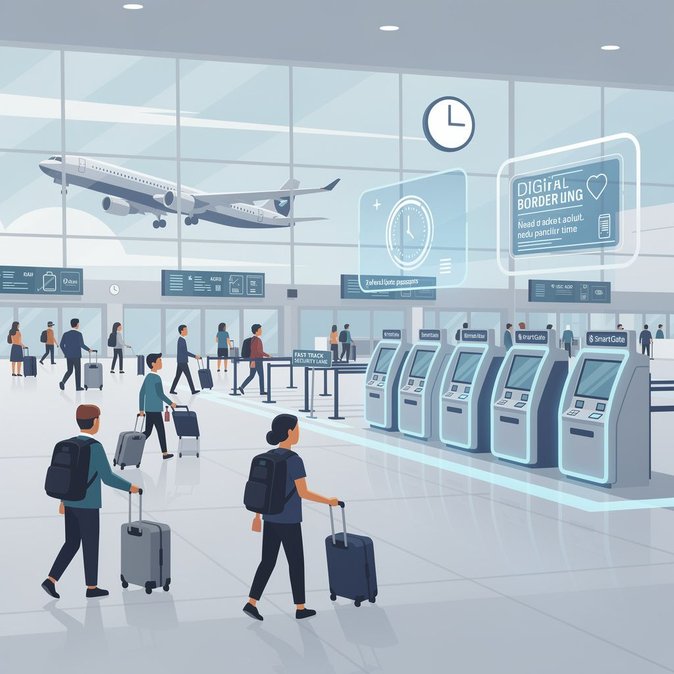
Sydney Airport is gearing up for one of its busiest travel peaks since the pandemic, forecasting nearly 2.7 million passengers between 21 September and 11 October—driven by school holidays, the AFL and NRL grand finals and the October long weekend. A record 94,000 domestic travellers are expected on Friday 2 October alone, with the international peak predicted a day earlier. To cope, the airport is deploying extra customer-service staff, redirecting some drop-off traffic to reduce kerb-side congestion and advising international travellers to arrive three hours before departure. Behind the scenes the airport will stress-test several passenger-flow innovations introduced over the past 12 months: self-service kiosks and auto bag-drops in Terminal 2, a Fast-Track priority lane at international security, and live wait-time displays on the SYD app. The surge provides an early trial of upgraded SmartGate e-Passport technology scheduled for nationwide rollout in 2027. Border agencies will monitor how the larger volumes interact with the facial-recognition gates and whether queue times remain within the 15-minute target. Any data gathered will inform the Australian Border Force’s digital-border program, including the transition from paper incoming-passenger cards to the Australia Travel Declaration. For corporate travel managers the advice is clear: allocate additional buffer time on itineraries and remind staff of new check-in processes. Freight forwarders moving time-critical cargo via belly-hold space should also anticipate tighter cut-off times as ramp operations stretch. While most airlines have added capacity to Queensland leisure routes, carriers report strong forward bookings to New Zealand, China and Singapore—useful indicators of demand as Asia-Pacific travel normalises. The airport’s CEO Scott Charlton says the period will “set a benchmark” for post-COVID peak management. With parliamentary inquiries scrutinising airport service levels, maintaining smooth flows during the holiday rush will be critical to arguments for future runway and terminal expansions.
Source: Sydney Airport Media Centre