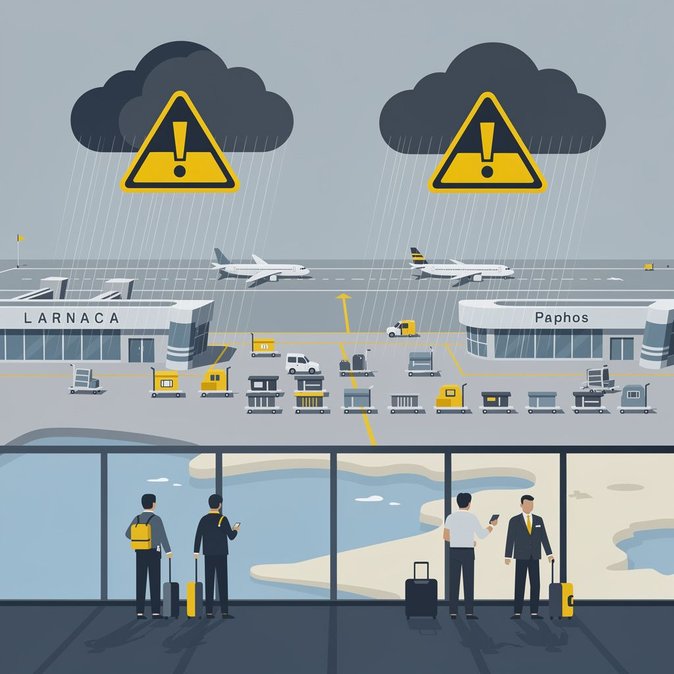
The Cyprus Department of Meteorology issued a yellow weather alert early on Sunday, 4 October 2026, warning of isolated but intense thunderstorms and hail across the island until 18:00. Forecasters said rainfall could reach 45–55 mm within three hours, with the south-west and mountainous areas expected to bear the brunt of the system. The warning quickly translated into operational headaches for carriers using Larnaca (LCA) and Paphos (PFO) airports. By midday, real-time flight boards showed a spike in departure delays, including a 79-minute hold on HiSky Europe flight H4 7726 to Bucharest and a 40-minute delay on British Airways BA 708 to London. Ground handlers told Cyprus Mail the combination of reduced visibility and apron flooding slowed baggage operations and forced a tactical redistribution of stands. Hermes Airports, the operator of both gateways, activated its adverse-weather contingency plan, re-routing arriving aircraft to remote stands and deploying extra buses to keep passenger flows moving. The company urged travellers to “check with their airline before leaving for the airport and allow additional time for security screening,” noting that short-notice gate changes were likely throughout the afternoon. Business-travel managers and mobility teams were advised to monitor crew-duty limits as rotation knock-ons could ripple into Monday’s early-morning departures—traditionally a high-yield segment for financial-services commuters flying to Athens, London and Tel Aviv. Travel-risk consultants emphasised that Cyprus is not yet part of Schengen, so any prolonged disruption can complicate onward connections that rely on minimum-connection-time calculations valid only within the common travel area. Although the yellow alert is the lowest on the three-tier scale, Cyprus’ infrastructure is vulnerable to flash flooding. The Fire Service confirmed 14 weather-related call-outs overnight, mainly involving stranded vehicles in Polis Chrysochous, Paphos and Famagusta. Travellers planning to drive onward from the airports should therefore verify road conditions—particularly on coastal B-class routes that are prone to water accumulation.
Source: Cyprus Mail