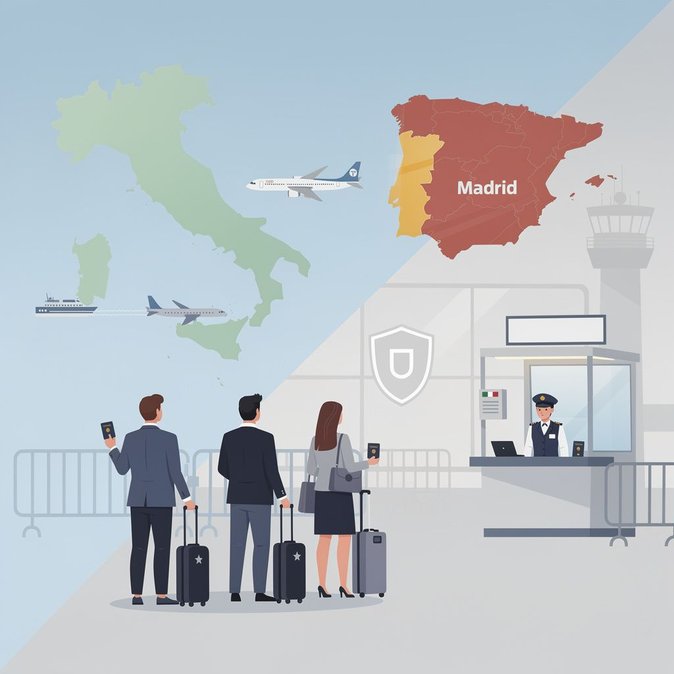
Spain’s Ministry of the Interior has issued Order INT/1033/2026, published in the Official State Gazette (BOE) on 6 October 2026, extending temporary border controls on passengers arriving from Italy by air or ferry for a further 14 days, from 00:00 on 8 October until 24:00 on 22 October. The checks were first introduced on 8 August after Rome imposed identical controls on travellers from Spain in response to the mass arrival of some 72,000 migrants in the Spanish enclave of Ceuta in late July. Spain has already renewed the measure twice (4 and 16 September). Interior Minister Fernando Grande-Marlaska argues that “persistent threats to public order and internal security” linked to secondary migrant movements and possible terrorist infiltration still justify the suspension of Schengen free-movement rules on this route. Practically, travellers flying or sailing from any Italian airport or port to Spain should expect passport inspection on arrival, even if they hold an EU national ID card. Airlines and ferry operators have been instructed to verify documents before boarding, and Spanish National Police will run selective checks on arrival gates and gangways. Spanish residents returning from Italy do not need additional paperwork, but they should allow extra connection time, especially at hubs such as Barcelona-El Prat and Palma de Mallorca, where queues of up to 30 minutes were reported during September’s control period. Corporate mobility managers should alert employees transiting through Italy en route to Spain that Schengen-internal connections are treated as quasi-international flights until 22 October. Carriers may deny boarding if passports or EU IDs are near expiry, and short self-transfer itineraries (under 60 minutes) are discouraged. Freight is unaffected, but courier staff travelling with hand-carried goods must clear the passenger control lanes. The Interior Ministry will reassess the measure on 20 October. Under the Schengen Borders Code, any further extension would require fresh justification and separate notification to the European Commission, keeping businesses guessing about potential additional disruption around the late-October travel peak.