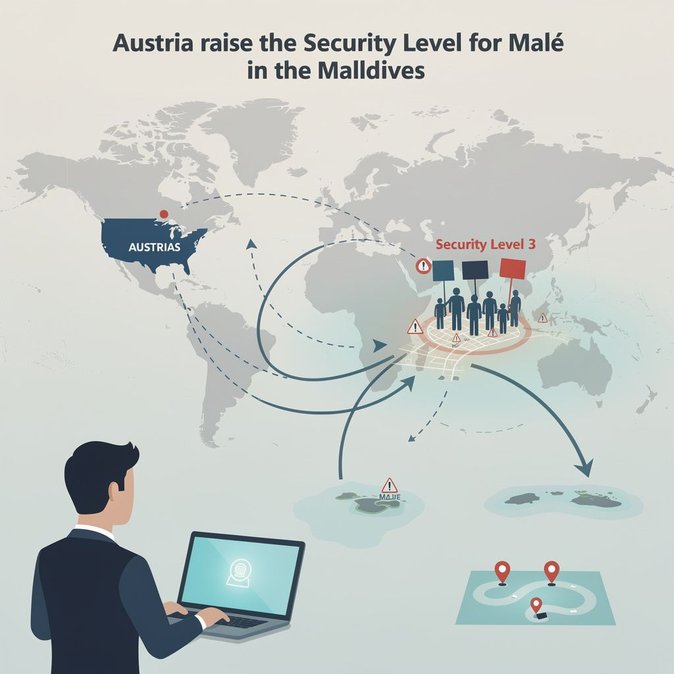
In a bulletin dated 7 October 2026, Austria’s Foreign Ministry escalated its security assessment for the Maldives, rating the capital Malé at Security Level 3 and advising Austrian nationals to avoid non-essential travel to the city. The rest of the archipelago is classified as Level 2, meaning travellers should exercise heightened caution. The elevated alert follows a string of politically-motivated protests and isolated bomb threats in Malé as the island nation grapples with post-election uncertainty. Although tourist islands and resort atolls remain largely unaffected, the ministry notes that transit through Malé’s Velana International Airport may be disrupted by demonstrations on the main access road and by sporadic strikes among ground-handling staff. For Austrian tour operators, the timing is sensitive: October launches the high season for European travellers. Contractual obligations with resort properties mean cancellations can carry hefty penalties, prompting many firms to reroute guests via seaplane transfers that bypass the capital. Companies with expatriate engineers overseeing resort construction are reviewing evacuation plans and verifying that local clinics stock adequate medicine for common diving injuries, as the advisory highlights limited medical capacity outside Malé. The guidance also has implications for business meetings tied to the Maldives’ blue-economy and renewable-energy projects, sectors where Austrian SMEs have signed feasibility MoUs. Virtual negotiations are now the preferred option until the security climate settles. Austrian citizens already in Malé are urged to stay indoors during protests, maintain flexible flight plans, and register with the Auslandsservice app. While the Maldives’ National Disaster Management Authority claims the situation is under control, regional security analysts advise corporates to treat the ministry’s Level 3 rating as a trigger for heightened duty-of-care protocols, including real-time location tracking and crisis-communication drills.