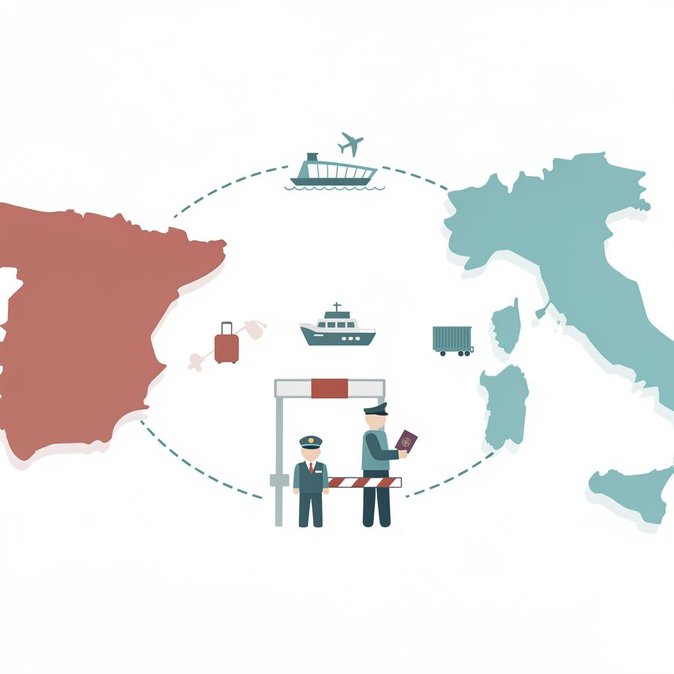
Spain has re-activated internal Schengen border controls at all Spanish air and sea entry points for passengers arriving from Italy. According to the European Commission’s live list of re-introductions, the measure entered into force at 00:00 on 8 October and will remain in place until 24:00 on 22 October 2026. Madrid justified the step on “continued threat to public policy, internal security and the management of migration flows” linked to recent mass entries of third-country nationals in the Schengen area and the risk of onward movements. For travellers, the practical effect is that Italian-origin passengers must expect passport checks upon arrival even though both countries belong to the normally control-free Schengen zone. Airlines have already started warning customers to allow extra time to clear inspection booths at Madrid-Barajas, Barcelona-El Prat and key ferry ports such as Barcelona and Valencia. Business passengers connecting to tight onward flights face the greatest disruption because dedicated fast-track facilities are not always available at temporary checkpoints. The Interior Ministry stresses that the decision mirrors similar controls imposed by Rome on Spanish travellers since 1 October as part of a tit-for-tat security posture. Companies moving staff between the two countries should review risk assessments, ensure employees carry valid travel documents and factor longer transit times into itineraries. Logistics operators handling just-in-time freight routed via ro-ro ferries also need to plan for possible delays while vehicle crews undergo ID screening. From a policy standpoint, the latest extension underscores how bilateral tensions tied to the Ceuta migration crisis continue to spill over into intra-EU mobility. Corporate mobility managers should monitor further notifications; under the Schengen Borders Code, Spain can renew the measure in rolling 15-day blocks for up to two months if the perceived threat persists.
Source: European Commission – DG HOME