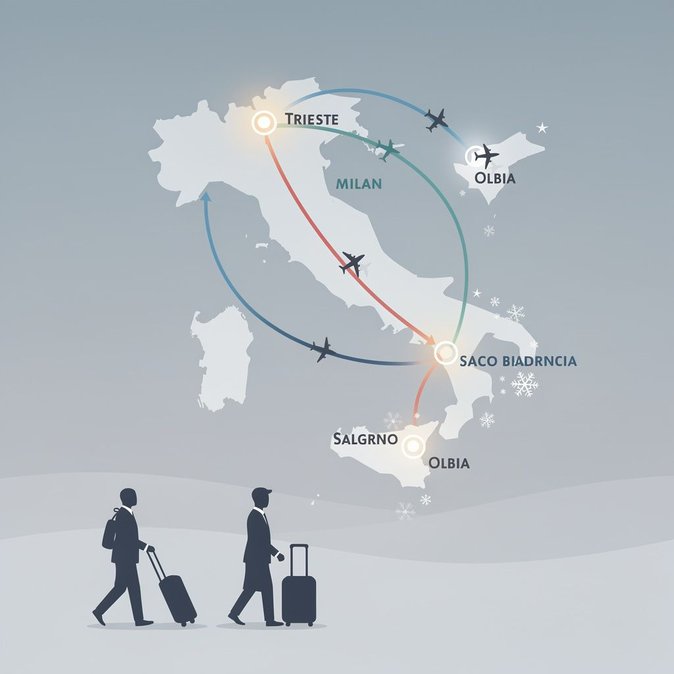
Regional carrier Aeroitalia is betting on pent-up holiday and corporate demand in Italy’s north-east. In a press release issued on 8 October 2026, Trieste Airport announced that the airline will increase frequencies on its Trieste–Salerno route and introduce seasonal services to Alghero and Olbia over the Christmas period. At the same time, the carrier confirmed that its territorial-continuity link between Trieste and Milan Linate—launched on 1 July—will run uninterrupted through the winter timetable. The capacity bump is modest in absolute numbers (from three to five weekly rotations on Salerno and twice-weekly round-trips to Sardinia), yet strategically significant. For local exporters in Friuli-Venezia Giulia the additional seats secure reliable access to Italy’s southern logistics hubs just as holiday traffic typically eats up availability. Human-resources teams managing commuters between head-office functions in Milan and engineering sites around Trieste also benefit from the guaranteed Linate service, which remains the shortest door-to-door link to Lombardy’s capital. Aeroitalia’s network tweak dovetails with Italy’s broader push to strengthen territorial-continuity obligations—public-service routes that keep peripheral regions plugged into the national economy. Under the current regime, carriers receive fee exemptions and priority slots in exchange for capacity commitments even during off-peak months. By expanding winter flights voluntarily, Aeroitalia is signalling confidence that demand has reached self-sustaining levels. For business-travel managers the news means more flight-time options and potentially lower last-minute fares on a corridor long dominated by high-cost rail. Travel-policy teams should update booking tools to reflect the added frequencies, particularly for employees planning December site visits or end-of-year audits in Campania and Sardinia. The extra capacity also reduces the need to route via Rome Fiumicino, shaving at least two hours off journey times. Trieste Airport, which handled 880,000 passengers in 2025, is positioning itself as a mini-hub linking the Adriatic to Italy’s industrial heartland. Its management hinted that further announcements could follow once the EU’s slot-co-ordination report for Summer 2027 is published in January.
Source: Trieste Airport – Press Release