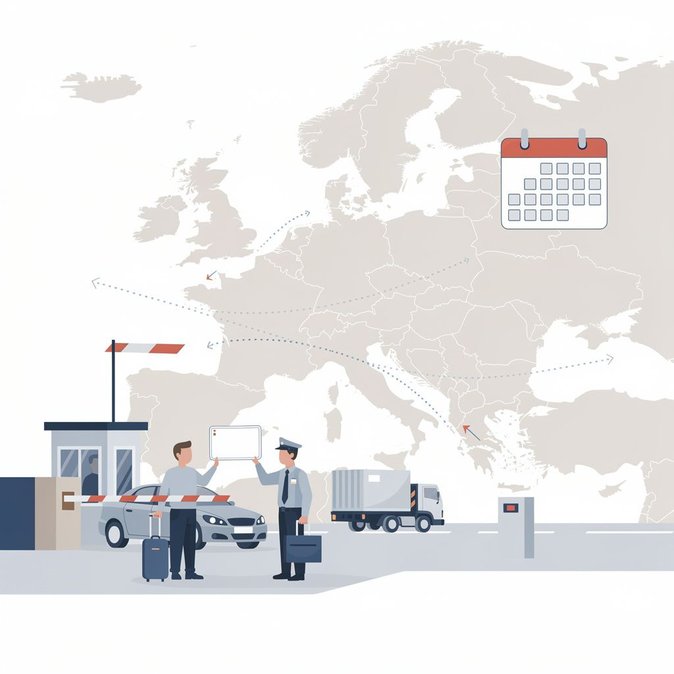
The Directorate-General for Migration and Home Affairs quietly refreshed its online dashboard of Schengen border-control notifications on 12 October, confirming that France has filed yet another six-month extension. Under the notice, France will maintain controls at all land, sea and air borders with Belgium, Germany, Luxembourg, Switzerland, Spain and Italy from 1 November 2026 through 30 April 2027. Paris cites “persistent jihadist threats, a rise in antisemitic attacks and migrant-smuggling networks” as the main security drivers. The announcement means France will have kept temporary internal checks in place for an unbroken stretch of eight and a half years since the November 2015 terror attacks. While the Schengen Borders Code describes such controls as a last-resort tool limited to two years, successive French governments have relied on Article 25a layered extensions, testing the legal elasticity of the regime. Brussels’ latest opinion accepts the proportionality argument but again “invites France to narrow both geographic scope and duration.” For cross-border commuters and business-travellers, the practical impact remains modest—ID checks at major road crossings are largely random—but logistics operators continue to report journey-time variability of up to 30 minutes at the Ventimiglia and La Junquera corridors. Eurostar and Thalys passengers face routine pre-departure screening, while private-aviation handlers must file passenger manifests 24 hours in advance. Companies running high-frequency road shuttles or time-critical deliveries should review contingency buffers before the 1 November change-over and brief drivers to carry proof of employment and assignment letters alongside passports. Mobility managers should also note that the extension overlaps with the Paris Peace Forum (10-11 November) and the busy Christmas travel window, periods when spot-checks intensify.
Source: European Commission – DG HOME