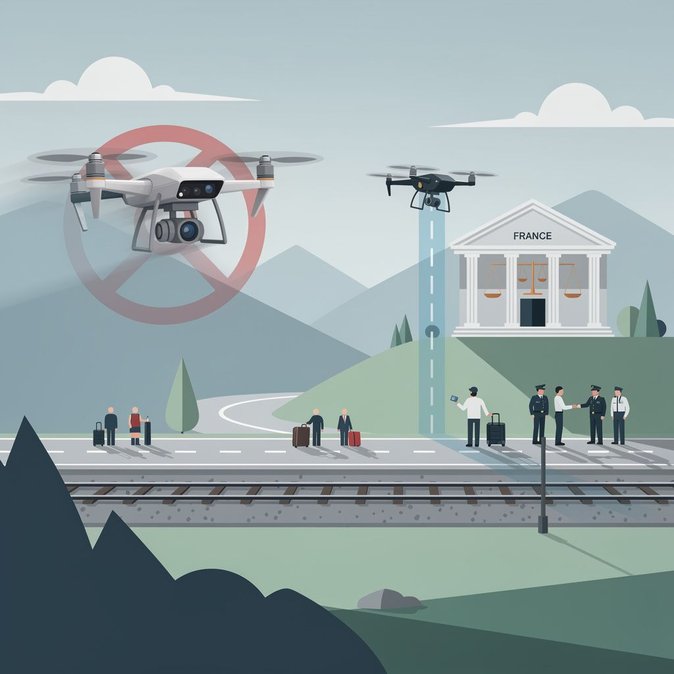
A ruling published on Monday, 16 November, by the administrative court in Nice has struck down two prefectural orders that authorised the use of camera-equipped drones to monitor irregular crossings along the rugged Franco-Italian frontier. The decrees, issued in February 2025 for a three-month period, covered wide swaths of the Roya and Menton valleys where migrants frequently attempt to enter France on foot or by train. Judges found that the prefecture failed to demonstrate why such large areas had to be filmed around the clock when conventional ground patrols were already in place at key crossing points. They concluded that the measures imposed a “disproportionate infringement of the right to privacy” because the necessity and proportionality tests laid down in France’s 2023 Internal Security Law were not met. Civil-liberties groups Ligue des droits de l’Homme and Anafé, joined by local farmer-activist Cédric Herrou, welcomed the verdict as a landmark reminder that border technology must remain tightly framed by law. Crucially, the decision does not amount to a blanket ban on drones: the prefect may still deploy them, but only if it can justify narrower geographic zones, time limits and clear data-retention safeguards. For corporates and mobility managers, the judgement is a bell-wether for how aggressively France can leverage high-tech surveillance in sensitive frontier regions. Companies moving staff or goods through the Nice–Ventimiglia corridor should anticipate tighter yet more targeted roadside checks while authorities redesign their toolkit. In the medium term, the ruling could shape national guidelines on police drones—especially with the Paris 2028 Olympics pushing demand for aerial monitoring. Travel providers should brief drivers that sporadic ground checkpoints may increase as a stop-gap, and immigration advisers should note that evidence gathered by drone is now more likely to be challenged in asylum and deportation cases. The case also signals to other EU states—Italy, Spain, Germany—that proportionality remains the decisive hurdle when rolling out border tech.
Source: Nice Mag