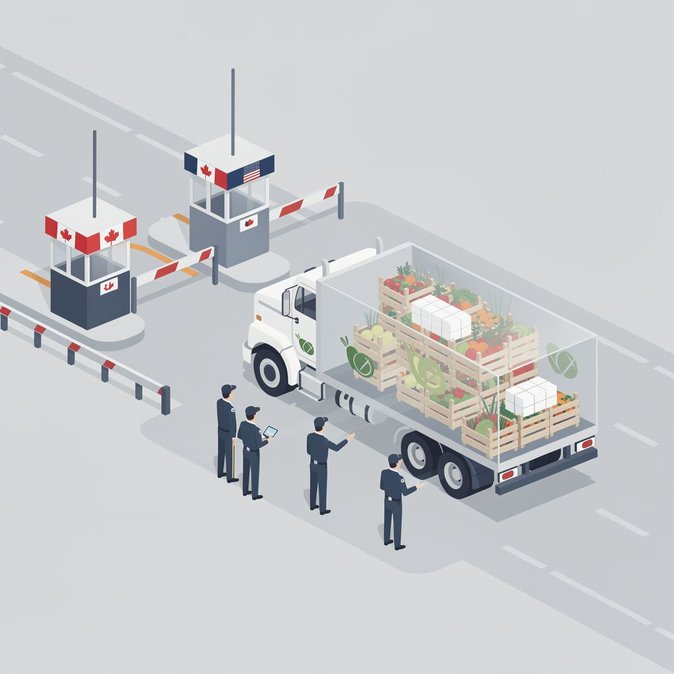
Canada’s border agency has underlined how the fight against organised crime and the protection of supply chains increasingly intersect with day-to-day trade. In a statement released on 17 November, the Canada Border Services Agency (CBSA) confirmed that officers at the Pacific Highway Commercial Operations port of entry in Surrey, British Columbia, discovered two duffel bags filled with 65 bricks of suspected cocaine – a total haul of 81 kilograms – concealed above boxes of romaine lettuce in a refrigerated trailer that arrived from the United States on 23 October. The driver was arrested on the spot and handed to the Royal Canadian Mounted Police (RCMP) Federal Policing Pacific Region’s Drugs and Organised Crime Section. An investigation is continuing. Although the seizure took place in late October, CBSA purposefully delayed publication until laboratory tests confirmed the substance and investigators had secured key evidence. Officials emphasised that the bust is part of a broader CA$1.3 billion, multi-year Border Plan that adds technology, X-ray imaging and additional frontline staff across the land border. The plan is designed to modernise commercial clearance while providing “a strong line of defence against organised crime,” Public Safety Minister Gary Anandasangaree said in the release. The incident offers practical lessons for logistics managers and drivers. CBSA highlighted how discrepancies in manifests and unusual routing patterns remain among the main behavioural triggers for secondary inspection. Companies carrying perishable goods should expect increased scrutiny if paperwork is incomplete or inconsistent, and should factor potential delays into delivery schedules, particularly on “green lane” fast-track routes such as Pacific Highway. For corporate travel managers, the case is a reminder that criminal enforcement activity can disrupt trusted-traveller and commercial programs at very short notice. Should an investigation require lane closures or a deep-search of multiple trucks in a queue, passenger vehicles and buses often face knock-on delays. Real-time monitoring of the CBSA Border Wait Times dashboard and contingency planning for last-minute itinerary changes remain best practice. More broadly, the seizure feeds into a narrative of closer North American border collaboration. Under the 2025 Canada-US Cargo Security Protocol, CBSA and US Customs and Border Protection (CBP) now share high-risk consignment data in near real time. That data-sharing arrangement was critical to identifying the truck in question, according to officials familiar with the file. Businesses engaged in cross-border trade should assume that risk-based targeting will keep tightening – and that compliance failures will increasingly have immigration as well as customs consequences for drivers and carriers.
Source: Canada Border Services Agency