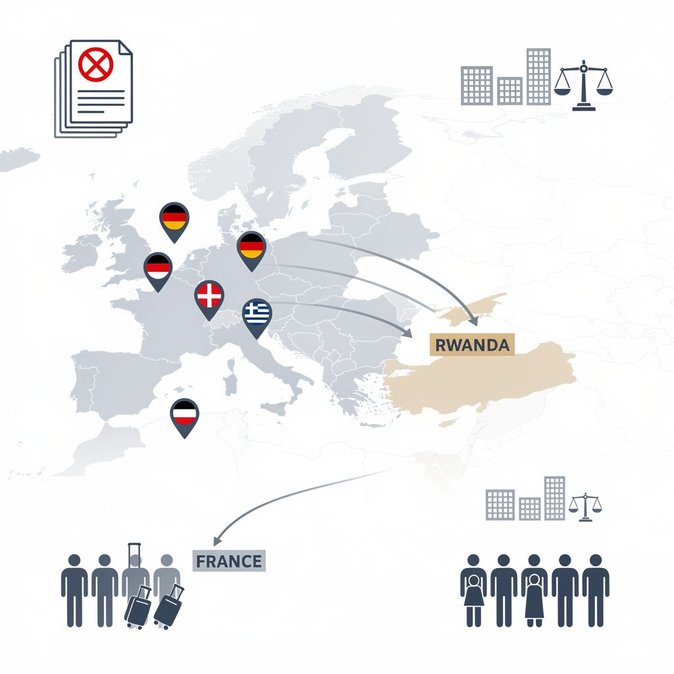
In Vienna on November 16, the interior ministers of Germany, Austria, Denmark, Greece and the Netherlands announced plans for a pilot ‘return hub’ in Rwanda that would take up to 100 migrants whose asylum claims have been finally rejected in their territories. The scheme, presented as a two-year trial to test the legality and logistics of offshore returns, would offer residence permits, training and employment support in Rwanda while removing the individuals from the EU. The participating governments argue that the centre will send a “powerful deterrent signal” to would-be irregular migrants and ease domestic political pressure after rising far-right electoral gains. France – which has maintained its own tough stance on border policing since the 2015 terrorist attacks – pointedly refused to join the initiative. President Emmanuel Macron told reporters that offshore processing is “neither effective nor compatible with French values”, citing legal and moral obstacles and the United Kingdom’s aborted Rwanda plan as cautionary tales. French diplomats also questioned the small scale of the pilot (100 people versus roughly 350,000 unenforced return decisions EU-wide each year) and warned of likely court challenges in Luxembourg and Strasbourg. For French multinationals and mobility managers the immediate impact is limited, but the announcement signals a harder European line on removals that could tighten compliance requirements for posted workers and business travellers whose residence rights lapse. Companies operating pan-EU projects from French hubs should expect more systematic exit checks and requests for proof of legal stay as member states seek to improve the currently low (27 %) enforcement rate of return orders. Practically, the French refusal means that rejected asylum-seekers in France will continue to be processed under existing national procedures rather than transferred to third-country hubs. However, pressure may mount on Paris to propose alternative efficiency measures—such as accelerating appeal timelines or expanding detention capacity—to avoid accusations of free-riding on tougher partners. HR teams should monitor upcoming debates on France’s draft immigration enforcement bill, expected to re-emerge in the Senate before year-end, which may incorporate stricter penalties for employers of irregular migrants. In the longer term, if the Rwanda pilot survives legal scrutiny and reduces arrivals in the five participating states, other EU governments—including France—could reconsider. Mobility stakeholders should therefore follow the pilot’s 2027 evaluation closely, as a broader rollout would radically alter the compliance landscape for family reunification and humanitarian applications across Schengen.
Source: Le Monde