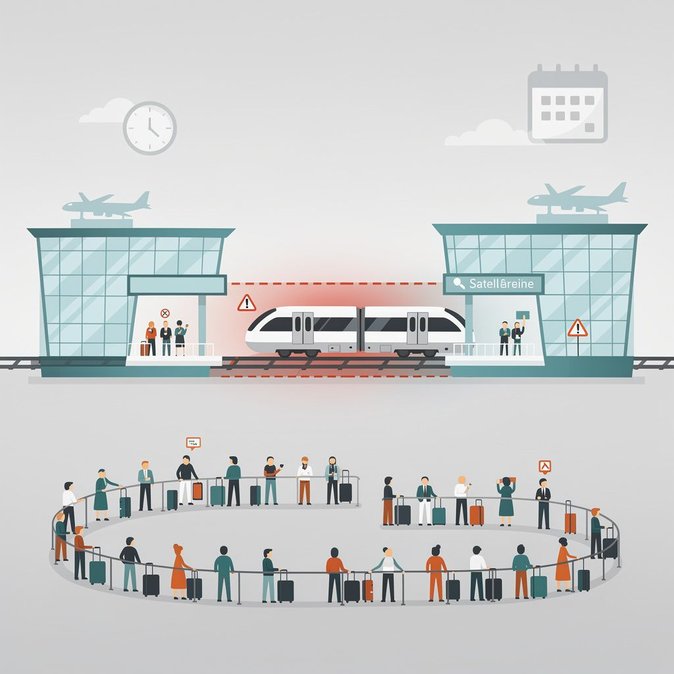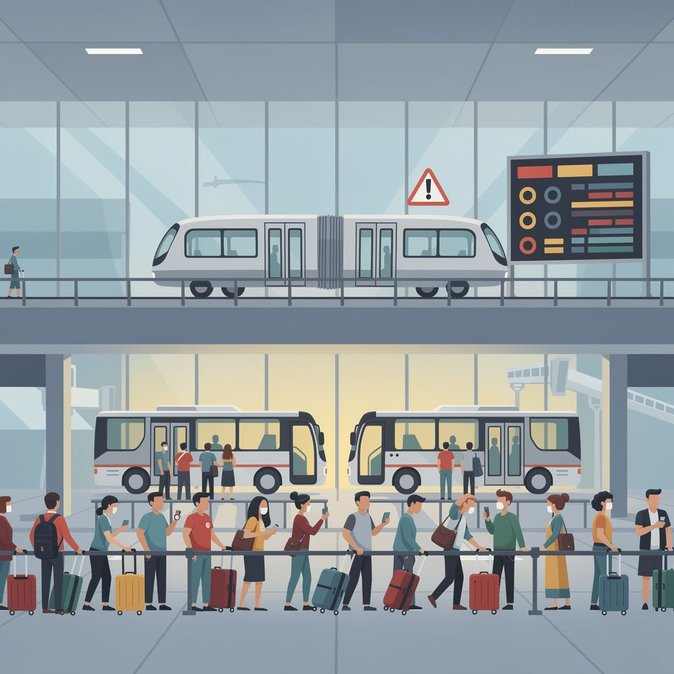
An unexpected technical failure on the automated people-mover that links Terminal 4 with the satellite building T4S at Madrid’s Adolfo Suárez Barajas Airport paralysed one of Europe’s busiest international hubs on Sunday, 22 November. The driverless train, operated by Alstom and normally running every three minutes, stopped shortly after noon local time. Aena, Spain’s airport authority, was forced to withdraw the four-car sets from service and deploy a fleet of replacement buses that could only move a fraction of the usual 8,000 passengers per hour. Within minutes, security lanes, passport control booths and boarding gates in T4S filled with growing lines of long-haul passengers bound for North and South America, the Middle East and Asia. Many worried about missing tight connections, especially because all non-Schengen flights at Barajas depart from the satellite building. Airlines urged customers via social media to arrive “at least one hour earlier than normal” and reassigned staff to shepherd premium and unaccompanied-minor passengers through makeshift queues. Business-travel consultants estimate that some 45 % of Spain’s corporate itineraries route through T4S because it hosts Iberia, oneworld partners and dozens of flag carriers. Sunday’s disruption therefore rippled across the network: Iberia delayed four departures to Latin America, Qatar Airways held its Doha flight for connecting traffic, and cargo handlers complained that high-value perishables sat on the apron in 25 °C sunshine. Although Aena stressed that no flights were cancelled, EU261 delay compensation may apply on several routes where departures slipped beyond the two-hour mark. By late afternoon, engineers managed to restart one of the two shuttle tracks in a limited, single-direction mode, but return journeys still required bussing. Aena said a full diagnostic would continue overnight and promised an update before the Monday morning rush. The incident is a reminder of the fragility of crucial “last-mile” infrastructure at major hubs just months before Barajas enters its peak Christmas traffic period. Travel-risk managers are advising multinational firms to factor longer minimum-connection times at MAD for the coming week and to brief mobile employees on alternative landside transfers between terminals should further faults occur.
Source: Cadena SER