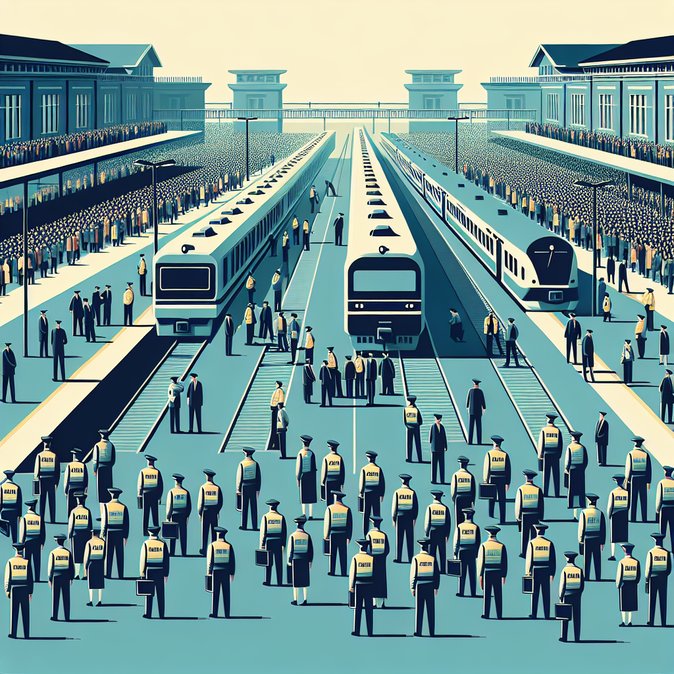
The Bundespolizei’s Hamburg command reported on 2 May that it fielded a 120-strong task force across the city’s main rail stations on Labour Day to monitor protest crowds and keep passenger flows moving. The special operation, established under a “Besondere Aufbauorganisation” (BAO), focused on Hamburg Hauptbahnhof, Altona, Jungfernstieg and Dammtor—four nodes that handle more than half a million travellers on a typical holiday. Officers from the Mobile Surveillance Unit and Federal Reserve Police conducted identity checks, managed platform access and coordinated with DB Sicherheit staff to re-route marchers away from choke points. The force reported no major disruption to regional or long-distance services; only nine temporary detentions were recorded, mostly for public-order offences. For corporate mobility teams the smooth outcome is a proof-of-concept for Germany’s growing use of rail-centric crowd-management on demonstration days. With air travel frequently hit by strikes, business travellers are shifting to rail; knowing that federal forces can scale up quickly at multi-modal hubs adds resilience. Employers sending staff through Hamburg during future high-profile events should still advise them to allow extra time, carry ID and monitor live updates via the Bundespolizei “BPOL” social-media feeds. The operation also hints at how domestic security resources could be redeployed when border controls are eventually rolled back: experienced rail units are likely to pivot to mobile Schengen compliance sweeps, a scenario mobility advisers should watch when planning travel-policy briefings.