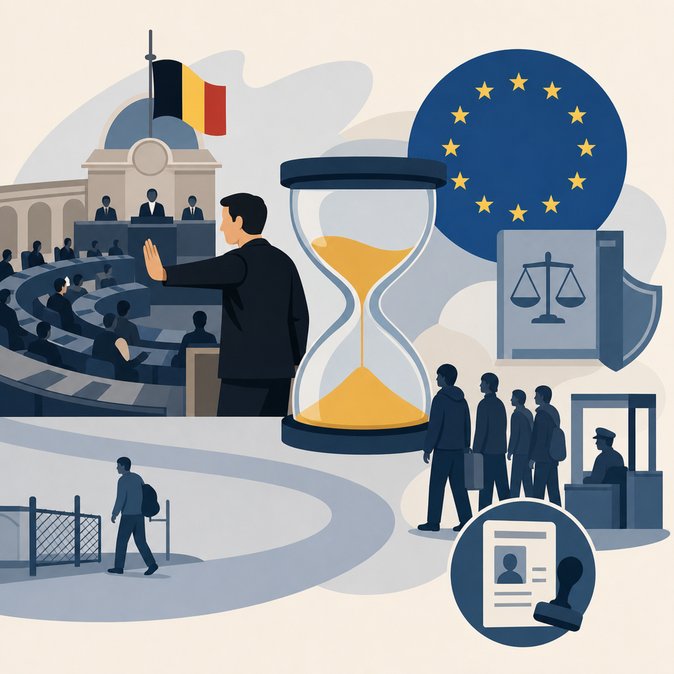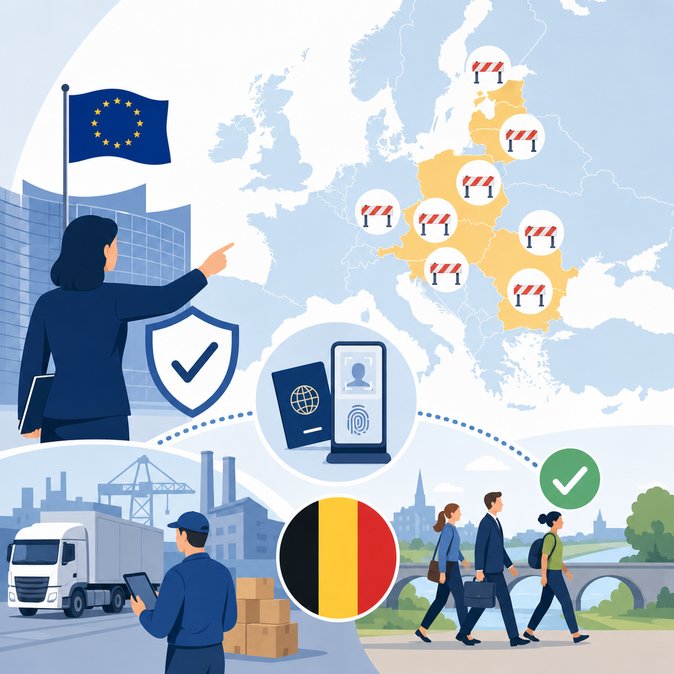
In a package of nine opinions issued on 2 June, the European Commission formally called on Austria, Denmark, France, Germany, Italy, the Netherlands, Norway, Slovenia and Sweden to phase out the internal border controls they have kept in place—some for more than eight years—within the passport-free Schengen Area. While Belgium does not currently run its own internal checks, the Commission stressed that neighbouring controls impose economic costs on Belgian hauliers, cross-border commuters and international visitors transiting through Brussels.
The Commission’s message is that the new external-border architecture—the biometrics-based Entry/Exit System (EES) that went live in April and the forthcoming European Travel Information and Authorisation System (ETIAS)—gives member states stronger tools to manage security threats without routine border posts. It recommends replacing systematic checks with mobile policing, vehicle tracking and real-time data-sharing between national forces.
Travellers and firms looking to understand how the new Schengen rules, the EES registration, or future ETIAS authorisations will affect their movements can save time by consulting VisaHQ. The platform’s Belgium portal (https://www.visahq.com/belgium/) offers up-to-date guidance on entry requirements, document checklists and application support, helping commuters and logistics managers stay compliant as border formalities evolve.
For Belgian businesses the announcement is significant. Haulage associations estimate that German and French border queues cost the Belgian logistics sector €32 million a year in lost driver hours. Technology companies servicing the EU institutions in Brussels have also complained about staff losing residence-permit validity days while stuck in border traffic, a factor that can trigger additional single-permit filings. The Commission will review progress again in September and has hinted it could open infringement proceedings if the nine states fail to present phase-out plans. Belgian companies that move goods or personnel through these borders should document current delays to help quantify claims if legal action results in compensation schemes.
The Commission’s message is that the new external-border architecture—the biometrics-based Entry/Exit System (EES) that went live in April and the forthcoming European Travel Information and Authorisation System (ETIAS)—gives member states stronger tools to manage security threats without routine border posts. It recommends replacing systematic checks with mobile policing, vehicle tracking and real-time data-sharing between national forces.
Travellers and firms looking to understand how the new Schengen rules, the EES registration, or future ETIAS authorisations will affect their movements can save time by consulting VisaHQ. The platform’s Belgium portal (https://www.visahq.com/belgium/) offers up-to-date guidance on entry requirements, document checklists and application support, helping commuters and logistics managers stay compliant as border formalities evolve.
For Belgian businesses the announcement is significant. Haulage associations estimate that German and French border queues cost the Belgian logistics sector €32 million a year in lost driver hours. Technology companies servicing the EU institutions in Brussels have also complained about staff losing residence-permit validity days while stuck in border traffic, a factor that can trigger additional single-permit filings. The Commission will review progress again in September and has hinted it could open infringement proceedings if the nine states fail to present phase-out plans. Belgian companies that move goods or personnel through these borders should document current delays to help quantify claims if legal action results in compensation schemes.