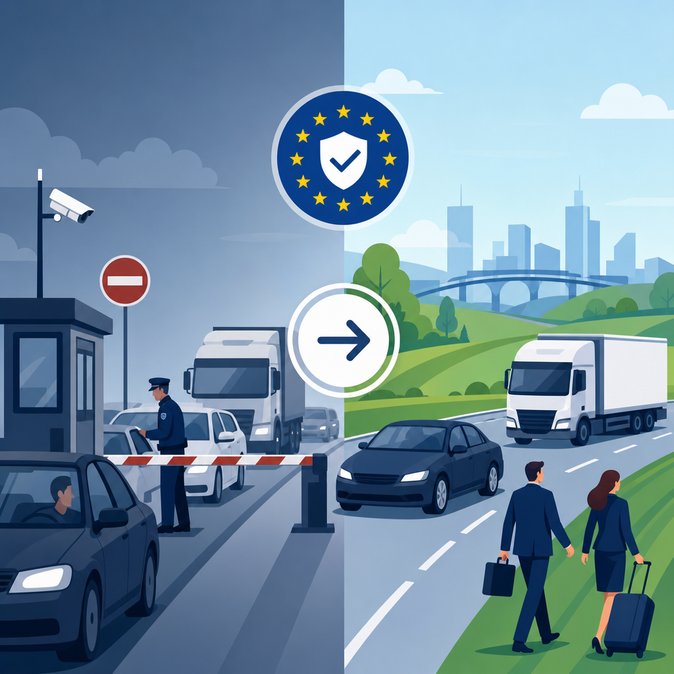
In a set of legally non-binding opinions released on 2 June 2026, the European Commission urged Germany—along with eight other member states—to draw up a roadmap for ending the internal border controls it has maintained with Austria, Czechia, Poland, Switzerland and France since 2024. The Commission’s German representation said the assessments concluded that the checks, repeatedly extended on security and migration grounds, are no longer proportionate and should be replaced by targeted police operations and new digital risk-analysis tools. Germany first reinstated fixed checks in September 2024 amid a sharp rise in irregular crossings and people-smuggling along the so-called Balkan route.
Companies grappling with these shifting requirements can simplify travel preparation through VisaHQ, an online service that helps travellers and corporate mobility teams obtain visas, passports and ancillary documents. Its Germany-focused portal (https://www.visahq.com/germany/) provides up-to-the-minute guidance on Schengen entry rules and work permit options—support that proves invaluable when border policies change with little notice.
While Berlin most recently prolonged the regime until mid-September 2026, freight forwarders and cross-border commuters complain of queues that add 30–60 minutes to journeys and disrupt time-critical supply chains. The Commission warned that such frictions undermine the free movement of goods and labour—cornerstones of the Single Market—and could cost businesses millions in lost productivity. For corporate mobility and global assignment teams the stakes are high. Many manufacturing plants in Bavaria and Saxony rely on technicians who commute daily from the Czech Republic or Austria. Longer waits at Kufstein or Waidhaus translate into overtime premiums and missed production targets. HR managers have resorted to issuing letters explaining the “essential worker” status of employees in the hope of faster processing, but border police have not recognised any fast-track lanes. The Commission’s report lists alternatives such as mobile patrols, automatic number-plate recognition and the EU’s Entry/Exit System (EES), which became fully operational in April 2026. If Germany embraces those measures, experts say companies could regain schedule certainty before the peak holiday season. However, the Interior Ministry reiterated that it will “review the recommendations carefully” while emphasising its constitutional duty to guarantee security. Mobility advisers should track the upcoming autumn decision. Should Berlin let the current order expire without renewal, cross-border postings, shuttle assignments and trucking operations would benefit immediately. Conversely, another extension could invite infringement proceedings and prolong the compliance burden of carrying passports, work permits and additional proof-of-employment when crossing what is, in principle, an open frontier.
Companies grappling with these shifting requirements can simplify travel preparation through VisaHQ, an online service that helps travellers and corporate mobility teams obtain visas, passports and ancillary documents. Its Germany-focused portal (https://www.visahq.com/germany/) provides up-to-the-minute guidance on Schengen entry rules and work permit options—support that proves invaluable when border policies change with little notice.
While Berlin most recently prolonged the regime until mid-September 2026, freight forwarders and cross-border commuters complain of queues that add 30–60 minutes to journeys and disrupt time-critical supply chains. The Commission warned that such frictions undermine the free movement of goods and labour—cornerstones of the Single Market—and could cost businesses millions in lost productivity. For corporate mobility and global assignment teams the stakes are high. Many manufacturing plants in Bavaria and Saxony rely on technicians who commute daily from the Czech Republic or Austria. Longer waits at Kufstein or Waidhaus translate into overtime premiums and missed production targets. HR managers have resorted to issuing letters explaining the “essential worker” status of employees in the hope of faster processing, but border police have not recognised any fast-track lanes. The Commission’s report lists alternatives such as mobile patrols, automatic number-plate recognition and the EU’s Entry/Exit System (EES), which became fully operational in April 2026. If Germany embraces those measures, experts say companies could regain schedule certainty before the peak holiday season. However, the Interior Ministry reiterated that it will “review the recommendations carefully” while emphasising its constitutional duty to guarantee security. Mobility advisers should track the upcoming autumn decision. Should Berlin let the current order expire without renewal, cross-border postings, shuttle assignments and trucking operations would benefit immediately. Conversely, another extension could invite infringement proceedings and prolong the compliance burden of carrying passports, work permits and additional proof-of-employment when crossing what is, in principle, an open frontier.