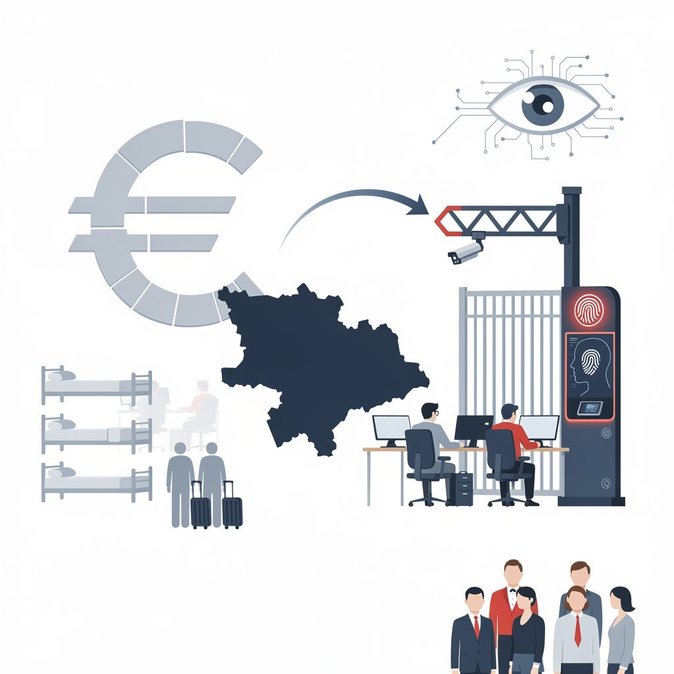
At a press conference in Vienna on 12 June 2026, Interior Minister Gerhard Karner unveiled a two-year federal security budget that reallocates spending from asylum reception to border-security technology and police staffing. The €4.1 billion annual envelope—unchanged in topline terms—will, however, see €180 million shifted from accommodation and basic-benefits lines into biometric equipment, forensic IT, and additional Frontex secondments. Karner argued that the EU Migration & Asylum Pact’s fast-track procedures will shorten average stay times in reception centres from the current 10 months to “well under four,” reducing per-capita costs. Savings will be reinvested in X-ray vans at major truck corridors and in upgrading e-gates at Vienna International Airport to handle the Entry/Exit System (EES). For global-mobility teams, the headline is that the ministry intends to add 120 civil-service posts to the Business Immigration Centre in Linz, aimed at cutting Red-White-Red Card processing to six weeks. Companies planning intra-company transfers should nevertheless anticipate transitional delays as case officers are retrained on the new EU rules. Karner also announced pilot use of AI-driven risk-profiling at the Slovenian border. Data-privacy advocates demand parliamentary oversight, warning that algorithmic scoring could lead to discriminatory checks on commuters from Slovenia and Hungary. The budget still requires approval in the National Council but enjoys broad coalition backing. If passed, procurement of 50 additional licence-plate-recognition cameras will start in July, with deployment along the A4 and A1 motorways by November—timed to coincide with the peak expatriate-relocation season for multinationals based around Vienna.
Source: Austrian Interior Ministry (BMI)