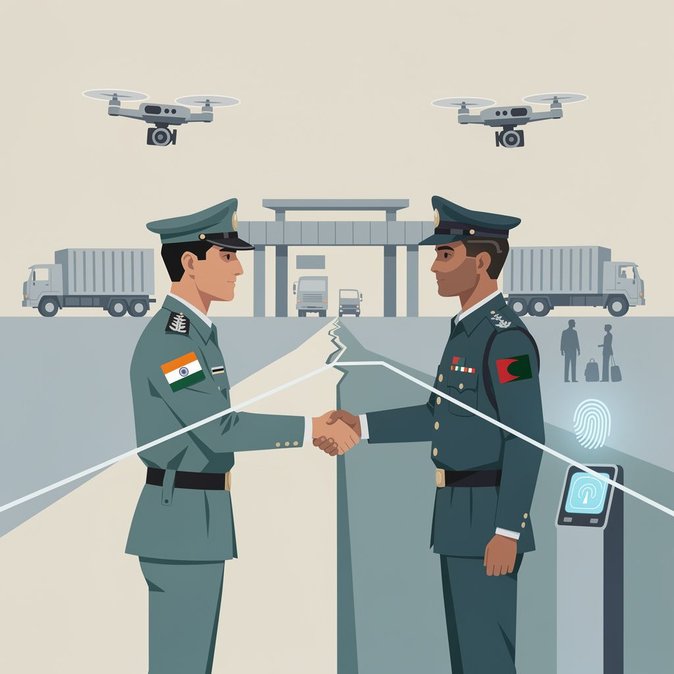
India and Bangladesh have sought to defuse months of tension over alleged undocumented migration by agreeing to a stronger, more technology-driven border-management plan. At the conclusion of a four-day Border Guard Bangladesh (BGB)–Border Security Force (BSF) conference in New Delhi on 12 June, the two sides released a joint statement committing to ‘real-time information-sharing, coordinated patrols and joint action against trans-border criminal networks’.
For travellers and businesses trying to keep pace with the evolving requirements, VisaHQ’s India page (https://www.visahq.com/india/) provides clear, continuously updated guidance on e-registration rules, visa options and passport services, helping ensure compliance before the new biometric checks take full effect.
The 4,096-km India–Bangladesh frontier is one of the world’s busiest land borders, with thousands of legitimate daily crossings for trade and family visits—but it is also a hotspot for smuggling, human trafficking and irregular movement of labour. Political pressure has risen since several Indian states ruled by the Bharatiya Janata Party stepped-up efforts to identify and deport Bengali-speaking Muslims they describe as ‘illegal infiltrators’. Dhaka, in turn, has accused Indian forces of conducting ‘push-ins’—forcibly returning migrants without due process. Under the refreshed Coordinated Border Management Plan, both forces will expand integrated check-posts, add additional flood-lit fence sections, deploy drone and satellite surveillance, and institute 24×7 hotlines at sector headquarters. A pilot facial-recognition system for passenger gates at Petrapole–Benapole—the busiest land port in South Asia—will be tested before a wider roll-out. The agreement also calls for joint public-awareness campaigns in border villages to curb trafficking and for faster verification of nationality in deportation cases. For businesses, the pact could mean shorter cargo-clearance times and fewer ad-hoc stoppages of trucks, a recurring complaint among exporters in West Bengal and Bangladesh’s Khulna division. Multinationals running factories in the Dhaka–Kolkata production corridor expect fewer shipment delays during the upcoming festive-season peak. However, rights groups urged transparency in any large-scale deportations and warned that excessive securitisation could slow legitimate commuter traffic for small traders. The two forces will reconvene in Dhaka in November to review progress. Corporate mobility managers should brief employees on the new biometric pilot, as travellers who do not comply with e-registration requirements may be denied boarding on cross-border buses or trains once the system is fully operational.
For travellers and businesses trying to keep pace with the evolving requirements, VisaHQ’s India page (https://www.visahq.com/india/) provides clear, continuously updated guidance on e-registration rules, visa options and passport services, helping ensure compliance before the new biometric checks take full effect.
The 4,096-km India–Bangladesh frontier is one of the world’s busiest land borders, with thousands of legitimate daily crossings for trade and family visits—but it is also a hotspot for smuggling, human trafficking and irregular movement of labour. Political pressure has risen since several Indian states ruled by the Bharatiya Janata Party stepped-up efforts to identify and deport Bengali-speaking Muslims they describe as ‘illegal infiltrators’. Dhaka, in turn, has accused Indian forces of conducting ‘push-ins’—forcibly returning migrants without due process. Under the refreshed Coordinated Border Management Plan, both forces will expand integrated check-posts, add additional flood-lit fence sections, deploy drone and satellite surveillance, and institute 24×7 hotlines at sector headquarters. A pilot facial-recognition system for passenger gates at Petrapole–Benapole—the busiest land port in South Asia—will be tested before a wider roll-out. The agreement also calls for joint public-awareness campaigns in border villages to curb trafficking and for faster verification of nationality in deportation cases. For businesses, the pact could mean shorter cargo-clearance times and fewer ad-hoc stoppages of trucks, a recurring complaint among exporters in West Bengal and Bangladesh’s Khulna division. Multinationals running factories in the Dhaka–Kolkata production corridor expect fewer shipment delays during the upcoming festive-season peak. However, rights groups urged transparency in any large-scale deportations and warned that excessive securitisation could slow legitimate commuter traffic for small traders. The two forces will reconvene in Dhaka in November to review progress. Corporate mobility managers should brief employees on the new biometric pilot, as travellers who do not comply with e-registration requirements may be denied boarding on cross-border buses or trains once the system is fully operational.