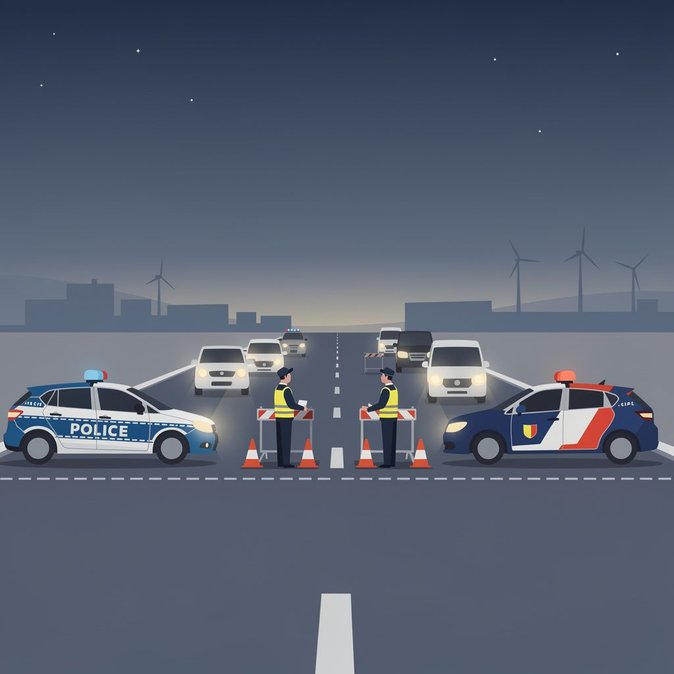
More than 100 French and Belgian police officers mounted a large-scale joint operation—code-named FUTURE—along the De Panne-Tournai corridor on the night of 11-12 June 2026. Checkpoints on both sides of the internal Schengen border focused on human-smuggling routes, drug trafficking, weapons and itinerant crime. Belgian units inspected 707 vehicles and 447 individuals, issuing 13 criminal reports for drug possession, two judicial arrests and 29 traffic fines. Five driving licences were immediately withdrawn for drug or alcohol offences, and one uninsured car was seized. Command and information exchange were coordinated through the permanent Police & Customs Cooperation Centre (CCPD) in Tournai, underscoring the value of real-time binational data sharing. While FUTURE was officially described as an anti-crime sweep, it also served as a stress test for the new EU Migration Pact’s provisions on cross-border police cooperation and returns. Officers from the Belgian Immigration Office were embedded to identify undocumented migrants who could be channelled into accelerated return procedures once national transposition is finalised. For cross-border commuters and logistics operators, the immediate impact was short delays on the E40 and secondary roads, a reminder that—even inside Schengen—pop-up checks remain lawful when justified by public-order concerns. Companies moving staff or cargo between northern France and Flanders should factor sporadic stops into journey-time calculations, especially on evenings when similar actions are announced. The operation’s intelligence component means data gathered will feed future “hit-day” interventions. Mobility managers should therefore ensure drivers carry duplicate copies of assignment letters, proof of social-security coverage and—where applicable—A1 certificates to avoid administrative hold-ups during subsequent spot checks.
Source: Belgian Federal Police