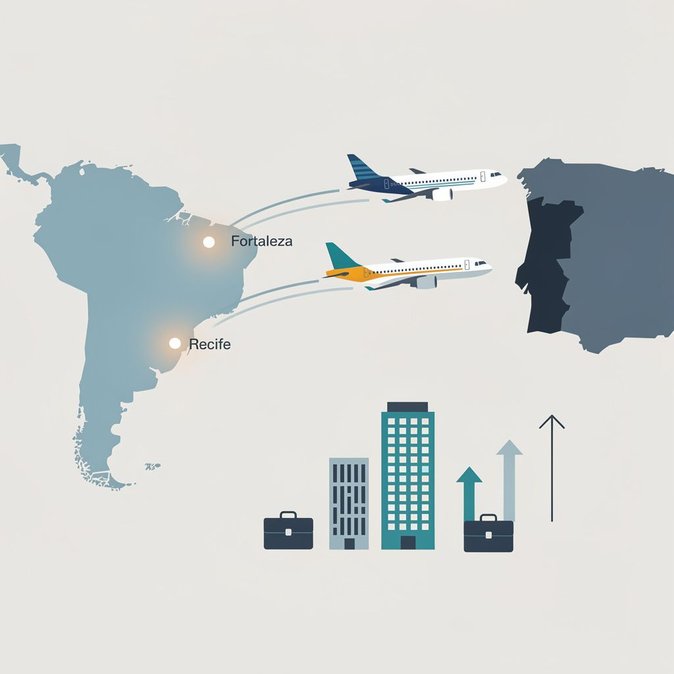
Brazil’s traditionally Europe-bound traffic funnels through São Paulo and Rio de Janeiro, but that pattern is shifting fast. Airline schedule filings published on 12 June show LATAM extending its Fortaleza–Lisbon service through at least March 2027 while TAP Air Portugal confirmed that its twice-weekly Recife–Porto operation will run year-round. Together, the announcements cement the role of the two northeastern capitals as Brazil’s emerging gateways to Europe. The move is driven by hard numbers. Passenger statistics from state tourism boards indicate that Recife/Guararapes handled 1.07 million international passengers in 2025, a 7 % jump on the previous year, while Fortaleza’s Pinto Martins Airport grew 9 % in the same period. Airlines have found that the six-to-seven-hour crossing to Portugal can be served profitably with single-aisle long-range aircraft such as the A321LR, opening thinner point-to-point routes that bypass the congested hubs further south. For corporate mobility planners the trend carries two immediate implications. First, executives based in Brazil’s interior now have a shorter domestic hop to reach Europe if they connect through the Northeast, shaving hours off door-to-door itineraries. Second, companies relocating staff to Europe may be able to negotiate lower fare structures out of Fortaleza or Recife than out of the legacy hubs, where fares remain buoyant. Travel-management firms report that some multinational clients have already rewritten corporate travel policies to allow routings via the Northeast when cost-effective. The economic spill-over is significant. Ceará and Pernambuco governments forecast that every new weekly international frequency supports roughly 80 direct jobs and stimulates hotel, restaurant and ground-transport spending across the coastal corridor. Real-estate developers have revived stalled resort projects on the back of the traffic projections, and the national Ministry of Tourism views the corridor as a pilot for dispersing foreign visitor revenue beyond Brazil’s Southeast. Challenges remain: both airports need surface-transport upgrades and a more extensive network of regional feed flights to sustain hub status. Yet analysts say the momentum is unmistakable; if fuel prices remain stable and exchange-rate conditions hold, Fortaleza and Recife could account for one in five Brazil–Europe seats by 2028, up from the current 11 %.
Source: The Traveler