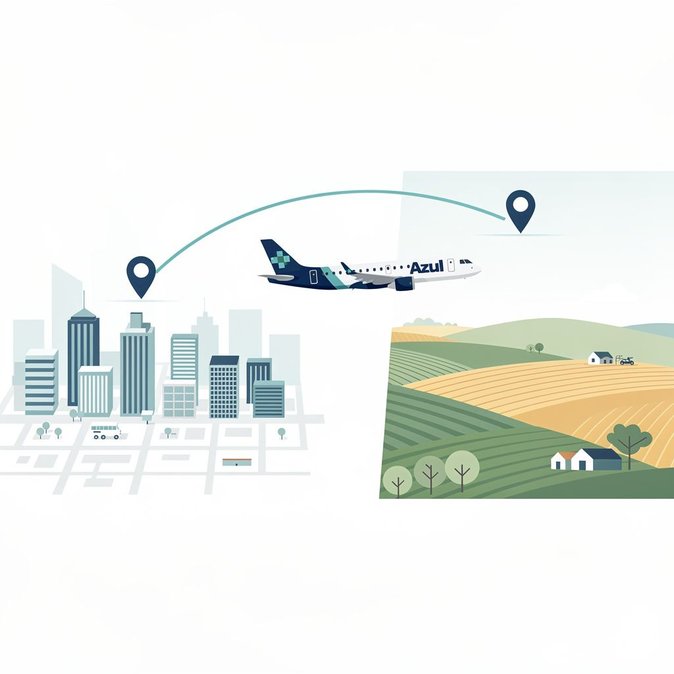
Low-cost carrier Azul opened ticket sales on 12 June for a new double-daily service between São Paulo–Congonhas (CGH) and Cuiabá–Marechal Rondon (CGB), to be launched in early September with Embraer E195-E2 aircraft. The move strengthens direct connectivity between Brazil’s main financial district — strategically located in the city-centre airport of Congonhas — and the capital of Mato Grosso, a powerhouse of the soybean, beef and cotton industries. Azul says the new flights, scheduled to leave CGH at 08:40 and 18:15 with returns at 06:00 and 15:45, will add more than 16 000 seats per month.
For international passengers — especially those combining the hop with onward connections or last-minute meetings — sorting out entry formalities can be almost as time-sensitive as grabbing a coveted Congonhas slot. VisaHQ’s Brazil portal (https://www.visahq.com/brazil/) accelerates visa procurement with online applications, concierge support and door-to-door passport logistics, helping executives, technicians and tourists stay compliant while focusing on their travel plans.
The route had long been demanded by agritech firms, commodities traders and consulting houses that shuttle executives between São Paulo HQs and farm-gate operations. Until now travellers had to connect in Brasília or fly from the more distant Guarulhos hub, adding at least two hours to door-to-door time. Congonhas slots remain some of the hardest to secure in Latin America. According to Azul’s institutional-relations chief Cesar Grandolfo, the airline was able to obtain the pair thanks to last year’s slot-diversity rule that redistributes peak-hour capacity toward new entrants. Mato Grosso’s state government is offering a temporary ICMS fuel-tax rebate to ensure the service’s viability in its first year. For mobility managers the flight shortens itineraries for expatriate engineers overseeing grain-terminal upgrades and eases same-day travel for due-diligence teams. The Embraer E2’s 25 % lower fuel burn versus previous-generation jets also helps companies pursuing scope-3 emission targets. Introductory one-way fares start at R$459 (approx. US$88). Azul said corporate and SME contracts can be amended immediately to include the new origin-destination pair; GDSs will show the flights as of 14 June.
For international passengers — especially those combining the hop with onward connections or last-minute meetings — sorting out entry formalities can be almost as time-sensitive as grabbing a coveted Congonhas slot. VisaHQ’s Brazil portal (https://www.visahq.com/brazil/) accelerates visa procurement with online applications, concierge support and door-to-door passport logistics, helping executives, technicians and tourists stay compliant while focusing on their travel plans.
The route had long been demanded by agritech firms, commodities traders and consulting houses that shuttle executives between São Paulo HQs and farm-gate operations. Until now travellers had to connect in Brasília or fly from the more distant Guarulhos hub, adding at least two hours to door-to-door time. Congonhas slots remain some of the hardest to secure in Latin America. According to Azul’s institutional-relations chief Cesar Grandolfo, the airline was able to obtain the pair thanks to last year’s slot-diversity rule that redistributes peak-hour capacity toward new entrants. Mato Grosso’s state government is offering a temporary ICMS fuel-tax rebate to ensure the service’s viability in its first year. For mobility managers the flight shortens itineraries for expatriate engineers overseeing grain-terminal upgrades and eases same-day travel for due-diligence teams. The Embraer E2’s 25 % lower fuel burn versus previous-generation jets also helps companies pursuing scope-3 emission targets. Introductory one-way fares start at R$459 (approx. US$88). Azul said corporate and SME contracts can be amended immediately to include the new origin-destination pair; GDSs will show the flights as of 14 June.