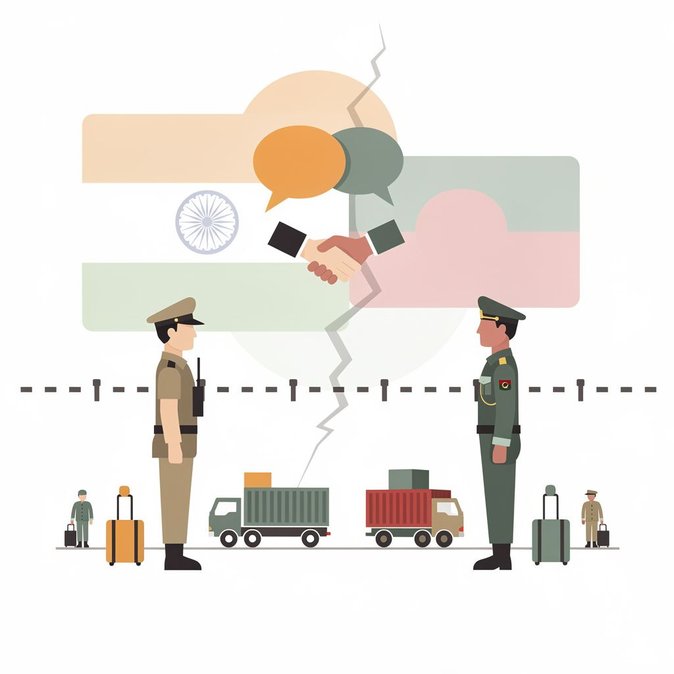
The 57th director-general-level talks between India’s Border Security Force (BSF) and Bangladesh’s Border Guard Bangladesh (BGB) concluded in New Delhi on 13 June with an unusually tense atmosphere. According to the BSF statement, discussions centred on the spike in “illegal/forcible crossings,” growing incidents of smuggling, and the politically sensitive issue of civilian deaths along the 4,096-km frontier. Behind the formal language, officials acknowledged that ground-level friction has intensified. Bangladeshi villagers have reportedly started patrolling their side of the fence, while Indian units have increased “push-back” operations—sending suspected undocumented migrants straight back across the border instead of formal deportation.
Amid such uncertainty, obtaining and renewing the right travel documents quickly becomes critical. VisaHQ’s India platform (https://www.visahq.com/india/) helps companies and individual travellers secure Indian, Bangladeshi and other regional visas, track applications in real time and receive policy alerts, providing a buffer when sudden border measures threaten to disrupt itineraries or supply-chain visits.
The BGB, in turn, raised “deep concern” over fatalities, demanding a “zero-death” policy. No joint press briefing was held—an unusual step that signals unresolved differences. Both sides nevertheless reaffirmed commitments to faster nationality verification and to strengthen the existing Coordinated Border Management Plan. For companies relying on the land route to move goods between West Bengal/Tripura and Bangladesh’s industrial hubs, continued cooperation is vital to keep cargo delays—and insurance costs—under control. For global-mobility managers relocating staff to India’s eastern states or to Bangladesh, the talks are a reminder that regulatory exposure extends beyond visas: unexpected border clampdowns can disrupt project timelines and supply chains. Multinationals with ‘fly-in/fly-out’ technicians should maintain contingency plans and monitor local advisories for flash-point districts in Meghalaya and West Bengal.
Amid such uncertainty, obtaining and renewing the right travel documents quickly becomes critical. VisaHQ’s India platform (https://www.visahq.com/india/) helps companies and individual travellers secure Indian, Bangladeshi and other regional visas, track applications in real time and receive policy alerts, providing a buffer when sudden border measures threaten to disrupt itineraries or supply-chain visits.
The BGB, in turn, raised “deep concern” over fatalities, demanding a “zero-death” policy. No joint press briefing was held—an unusual step that signals unresolved differences. Both sides nevertheless reaffirmed commitments to faster nationality verification and to strengthen the existing Coordinated Border Management Plan. For companies relying on the land route to move goods between West Bengal/Tripura and Bangladesh’s industrial hubs, continued cooperation is vital to keep cargo delays—and insurance costs—under control. For global-mobility managers relocating staff to India’s eastern states or to Bangladesh, the talks are a reminder that regulatory exposure extends beyond visas: unexpected border clampdowns can disrupt project timelines and supply chains. Multinationals with ‘fly-in/fly-out’ technicians should maintain contingency plans and monitor local advisories for flash-point districts in Meghalaya and West Bengal.