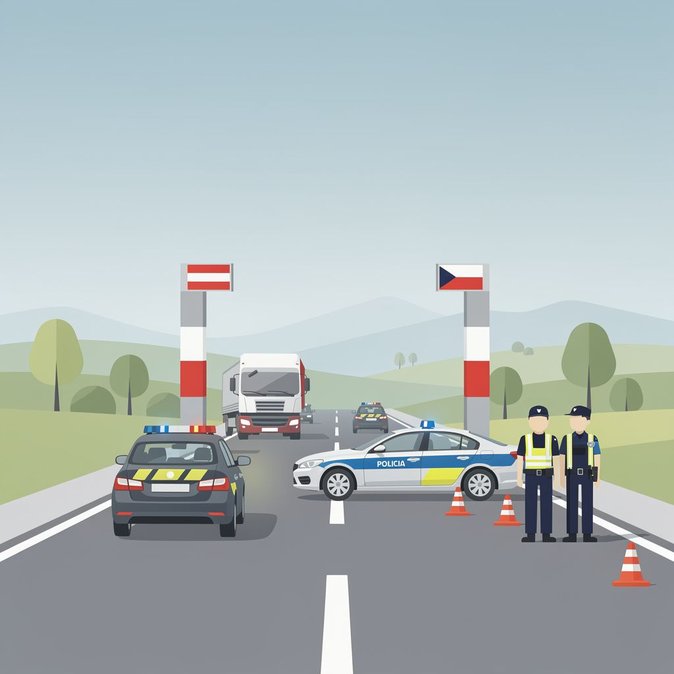
Czech authorities moved quickly on Sunday to reinforce policing along the 466-kilometre frontier with Austria after Vienna confirmed a fresh extension of its internal Schengen controls. The Interior Ministry said an additional 200 officers from regional rapid-response units have been redeployed to major crossings such as Dolní Dvořiště/Wullowitz and Mikulov/Drasenhofen as well as to smaller back-roads and selected green-border sectors. The measure is temporary and will be “continuously adjusted to the migration situation,” the ministry’s spokeswoman Lucie Nováková noted.
For travellers unsure about documentation requirements when entering or leaving Czech territory, VisaHQ offers up-to-date guidance on visas, residence permits, and other paperwork. Their online platform (https://www.visahq.com/czech-republic/) lets users check whether they need any additional documents and can even arrange courier submissions, so commuters and business visitors can avoid last-minute surprises at ad-hoc police checkpoints.
Unlike Austria, Prague is not re-introducing systematic exit checks; Czech officers will conduct mobile patrols on the domestic side to deter smugglers heading north after being pushed back by Austrian police. The stepped-up presence follows a bilateral agreement reached “yesterday” between the Czech and Slovak interior ministers, under which both countries pledged mutual assistance if migrant pressure shifts eastwards. For cross-border workers—an estimated 12,000 Czechs commute daily to jobs in Upper Austria—the visible show of force is mostly symbolic: drivers will still clear the actual state line unhindered. However, they may encounter spot checks a few kilometres inland, where officers can ask for IDs and vehicle documents. Hauliers have been told that lorry inspections will focus on human-smuggling risks rather than customs enforcement, so delays should stay below 15 minutes per stop. Legal practitioners point out that the deployment underscores Czechia’s wider shift toward “flexible” border management ahead of the Entry/Exit System (EES) launch in October. Companies posting non-EU staff to Austria should make sure that posted-worker notifications and A1 forms are easily accessible on mobile devices: failure to present paperwork during a roadside stop can incur on-the-spot fines in Austria. HR impact: Mobility teams should brief employees that extra police patrols are Czech—not Austrian—so travellers re-entering Czechia may also be stopped. Employees holding dual nationality or residence rights only in another EU state should carry proof of legal stay in Czechia (e.g., confirmation of temporary residence) to avoid misunderstandings.

For travellers unsure about documentation requirements when entering or leaving Czech territory, VisaHQ offers up-to-date guidance on visas, residence permits, and other paperwork. Their online platform (https://www.visahq.com/czech-republic/) lets users check whether they need any additional documents and can even arrange courier submissions, so commuters and business visitors can avoid last-minute surprises at ad-hoc police checkpoints.
Unlike Austria, Prague is not re-introducing systematic exit checks; Czech officers will conduct mobile patrols on the domestic side to deter smugglers heading north after being pushed back by Austrian police. The stepped-up presence follows a bilateral agreement reached “yesterday” between the Czech and Slovak interior ministers, under which both countries pledged mutual assistance if migrant pressure shifts eastwards. For cross-border workers—an estimated 12,000 Czechs commute daily to jobs in Upper Austria—the visible show of force is mostly symbolic: drivers will still clear the actual state line unhindered. However, they may encounter spot checks a few kilometres inland, where officers can ask for IDs and vehicle documents. Hauliers have been told that lorry inspections will focus on human-smuggling risks rather than customs enforcement, so delays should stay below 15 minutes per stop. Legal practitioners point out that the deployment underscores Czechia’s wider shift toward “flexible” border management ahead of the Entry/Exit System (EES) launch in October. Companies posting non-EU staff to Austria should make sure that posted-worker notifications and A1 forms are easily accessible on mobile devices: failure to present paperwork during a roadside stop can incur on-the-spot fines in Austria. HR impact: Mobility teams should brief employees that extra police patrols are Czech—not Austrian—so travellers re-entering Czechia may also be stopped. Employees holding dual nationality or residence rights only in another EU state should carry proof of legal stay in Czechia (e.g., confirmation of temporary residence) to avoid misunderstandings.