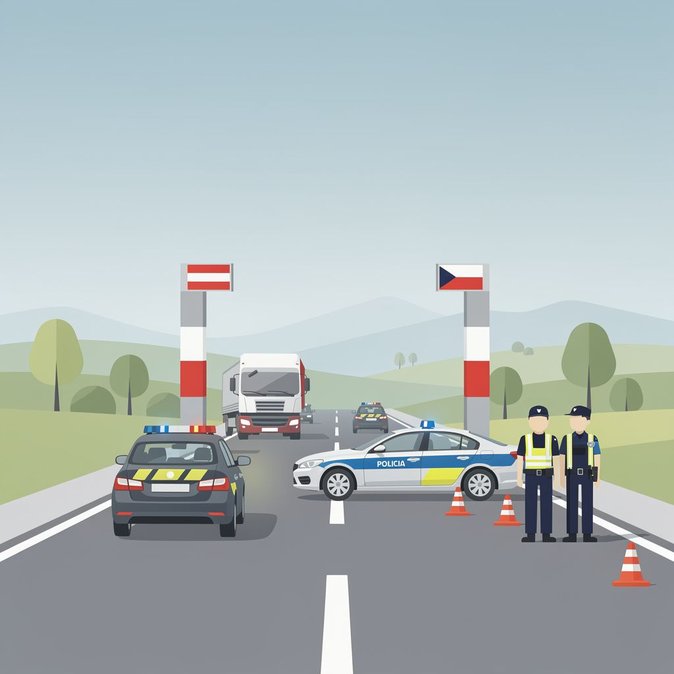
Austria has confirmed that the temporary controls it re-introduced on its internal Schengen borders with the Czech Republic, Slovakia, Hungary and Slovenia will remain in force for at least another three months from Monday, 15 June 2026. Interior Minister Gerhard Karner announced the decision in Vienna on 13 June, insisting that “additional measures to secure Austria’s border regions remain necessary” despite the new EU Migration and Asylum Pact entering into application this week. Under the renewed decree, Austrian police will continue to run a mix of mobile patrols, spot checks on secondary roads and targeted inspections at major crossings such as Hatě/Kleinhaugsdorf and Mikulov/Drasenhofen. Karner said the strategy—shifted in 2025 from static checkpoints to so-called “Grenzraumkontrollen”—aims to disrupt people-smuggling networks while minimising delays for regular commuters and freight. Nevertheless, Czech logistics operators report average transit times for trucks on the D52/A5 corridor have risen by 20–30 minutes since controls were reinstated in 2023, forcing some just-in-time suppliers to build extra buffer stock. The extension lands at the start of the summer holiday season, when tens of thousands of Czech tourists drive south via Austria to Croatia and Italy. The Czech Automobile Club (ÚAMK) is advising motorists to keep passports and vehicle papers readily accessible and to budget up to an hour of additional travel time on peak Fridays. Travel agencies say coach operators will stagger departures to avoid early-morning bottlenecks, while rail operator RegioJet has flagged possible schedule padding on its Prague–Vienna services if spot checks expand to passenger trains. Prague has so far resisted mirroring Vienna’s measures. Interior Minister Vít Rakušan reiterated over the weekend that Czechia “reserves the right to introduce reciprocal checks if migration pressure shifts routes, but for now our priority is to keep the border as open as possible for workers and tourists.” The European Commission, which earlier this month urged nine Schengen states to phase out internal controls, said it “takes note” of Austria’s notification but will review proportionality once again in September. For mobility managers the message is clear: cross-border assignments and supply chains involving Austria will face another quarter of friction. Companies are telling posted workers to carry employment contracts and proof of accommodation in case of roadside inspections, and freight forwarders are adding electronic transit documents to speed up on-the-spot verifications. With no guarantee that controls will end in autumn, multinationals with twin-plant operations in Brno and Linz are already exploring alternative routings via Slovakia to protect service-level agreements.
Source: České Noviny / ORF / Kanal1