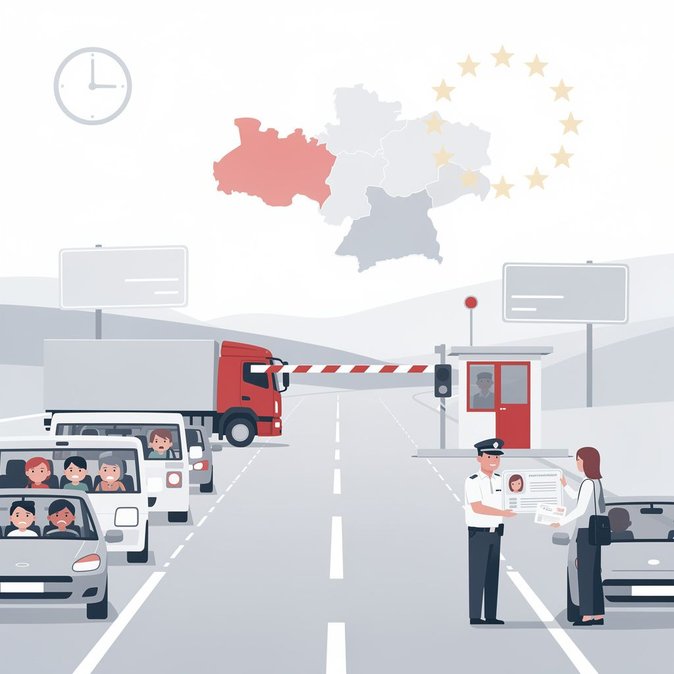
Austria’s interior ministry has confirmed that the temporary checks it runs on the land frontier with Czechia, Slovakia, Hungary and Slovenia will not expire on Monday as scheduled but will instead roll on for another three-month period. Interior Minister Gerhard Karner said Vienna needs “flexible and effective controls in the border region” while the EU’s new Migration & Asylum Pact is put into practice and external-border security is reinforced. Although the controls are described as mobile spot-checks rather than permanent booths, they have real-world consequences for cross-border businesses and commuters. Truckers on the Prague–Linz corridor already report delays of 30–60 minutes at peak times, disrupting just-in-time supply chains for the automotive and electronics sectors clustered along the D3/S10 route. Czech export federation ČESK EXIM estimates that every extra half-hour at the border costs manufacturers about CZK 4 million a day in lost productivity. Karner’s announcement comes despite the European Commission’s early-June recommendation that nine Schengen states, including Austria and Germany, phase out internal checks and rely instead on police cooperation and intelligence-led patrols. Austria first re-introduced controls during the 2015 refugee crisis and, like Germany, has repeatedly renewed them on security grounds. Prague’s Ministry of the Interior called the extension “regrettable but understandable”, noting that close to 13,000 irregular migrants were intercepted on the Czech-Slovak route last year—many of whom later tried to enter Austria. Czech firms urged both governments to deploy more joint mobile units so that routine commuters with A1 forms or business invitations are waved through quickly. For mobility managers the message is clear: build extra buffer time into itineraries for road shipments and employee travel between now and mid-September. Air and rail links are unaffected, but any staff driving company cars across the Austrian border should carry passports and proof of employment to avoid secondary checks.
Source: ČeskéNoviny.cz