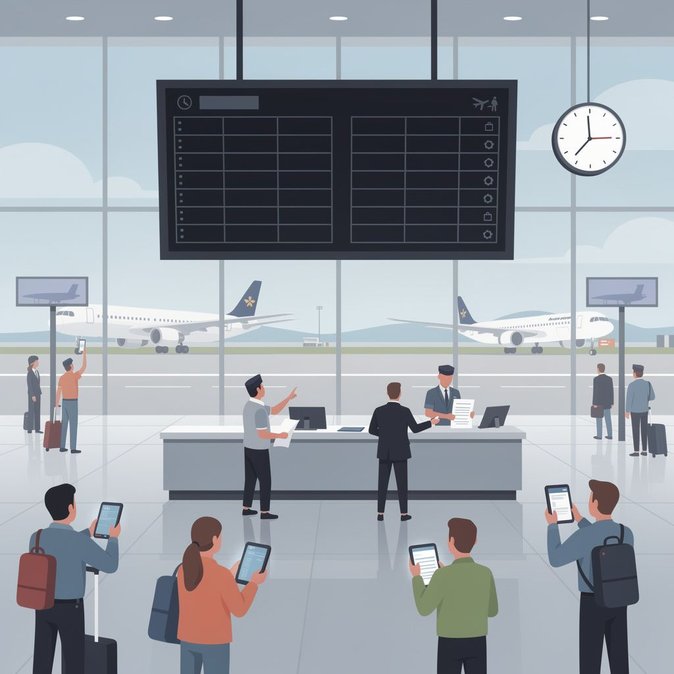
Business and leisure travellers passing through Prague’s Vaclav Havel Airport faced confusion on Friday afternoon after a widespread failure of the airport’s information systems knocked out flight-information displays, staff e-mail and the public website. The outage, first reported on social network X at 13:55 local time, left departure boards in both terminals blank and forced airlines to make manual boarding announcements.
In situations like these, having travel documentation squared away removes one more stress factor. VisaHQ’s Czech Republic page (https://www.visahq.com/czech-republic/) offers fast visa assessments, application support and real-time status tracking so that passengers stuck waiting for gate updates can at least be confident their paperwork is in order.
Airport spokeswoman Klára Divíšková confirmed that no security or air-traffic systems were affected, but urged passengers to monitor airline apps for real-time updates. The breakdown coincided with the start of the peak summer travel season and a 12 per cent year-on-year jump in Friday traffic volumes, according to airport data. Long queues quickly formed at the transfer desks as connecting passengers sought gate information. Several carriers, including Lufthansa and Smartwings, delayed departures by up to 45 minutes to allow passengers extra time to reach the correct gates. Ground handlers resorted to whiteboards and printed gate lists, a throwback to practices not seen since the pre-digital era. Although check-in kiosks remained operational, baggage-tracking tags could not be synchronised with the central database, raising fears of mishandled luggage. The airport activated its contingency plan within 30 minutes, deploying additional staff and opening a back-up operations room housed in Terminal 3. By 17:30 the IT team had partially restored internal e-mail and announced that full functionality of the FIDS display network would take “several more hours.” Management declined to comment on the root cause, pending a forensic review, but cyber-security experts note that European airports have reported a surge in ransomware attempts since Russia’s 2022 invasion of Ukraine. For mobility managers the incident is a reminder to brief travellers on airline mobile apps and to allow extra connection time during the high-traffic summer months; Prague handled 13.8 million passengers last year and expects to exceed 15 million in 2026.
In situations like these, having travel documentation squared away removes one more stress factor. VisaHQ’s Czech Republic page (https://www.visahq.com/czech-republic/) offers fast visa assessments, application support and real-time status tracking so that passengers stuck waiting for gate updates can at least be confident their paperwork is in order.
Airport spokeswoman Klára Divíšková confirmed that no security or air-traffic systems were affected, but urged passengers to monitor airline apps for real-time updates. The breakdown coincided with the start of the peak summer travel season and a 12 per cent year-on-year jump in Friday traffic volumes, according to airport data. Long queues quickly formed at the transfer desks as connecting passengers sought gate information. Several carriers, including Lufthansa and Smartwings, delayed departures by up to 45 minutes to allow passengers extra time to reach the correct gates. Ground handlers resorted to whiteboards and printed gate lists, a throwback to practices not seen since the pre-digital era. Although check-in kiosks remained operational, baggage-tracking tags could not be synchronised with the central database, raising fears of mishandled luggage. The airport activated its contingency plan within 30 minutes, deploying additional staff and opening a back-up operations room housed in Terminal 3. By 17:30 the IT team had partially restored internal e-mail and announced that full functionality of the FIDS display network would take “several more hours.” Management declined to comment on the root cause, pending a forensic review, but cyber-security experts note that European airports have reported a surge in ransomware attempts since Russia’s 2022 invasion of Ukraine. For mobility managers the incident is a reminder to brief travellers on airline mobile apps and to allow extra connection time during the high-traffic summer months; Prague handled 13.8 million passengers last year and expects to exceed 15 million in 2026.