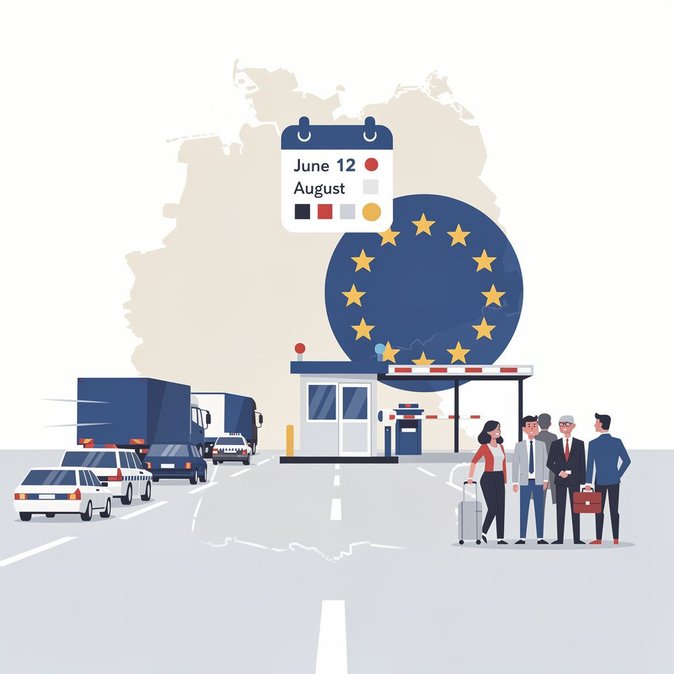
Only three days after the long-negotiated EU Pact on Migration and Asylum (GEAS) entered into force, Bavaria’s governing Christian Social Union (CSU) signalled that it has no intention of rolling back the stationary border controls introduced in 2024. Speaking to reporters after a party board meeting in Munich on 15 June 2026, party chairman Markus Söder argued that GEAS will need “a lengthy implementation phase” and that abandoning checks now would be a mistake. Landesgruppenchef Alexander Hoffmann added that earlier EU reforms have often taken years to become fully operational and that Germany must therefore “hold the line” at its land borders. Germany re-introduced systematic controls with Austria, the Czech Republic, Poland, Switzerland, Denmark, the Netherlands, France and Luxembourg in September 2024, citing secondary movements and gaps at the EU’s external borders. The regime has since been renewed three times and is currently authorised until mid-September 2026. Under Schengen rules, such long-term suspensions of free movement are meant to be exceptional and have drawn criticism from Brussels and neighbouring capitals. Business-travel managers had hoped that the new pact – which harmonises asylum procedures and introduces mandatory solidarity between member states – would pave the way for a gradual return to passport-free travel. The CSU’s stance dims that prospect. Continued controls translate into sporadic queues for cross-border commuters, delivery trucks and tourists and require companies to factor buffer time into itineraries. Airlines have also complained about passengers missing flights after road delays around Munich and Frankfurt. The federal government, a CDU/CSU-FDP coalition, has so far kept its options open. Interior Minister Alexander Dobrindt is expected to review the necessity of the controls in August, but with Bavarian state elections due in October the political appetite for easing measures appears limited. Mobility planners should therefore assume rolling extensions well into 2027.
Source: dpa-AFX via FinanzNachrichten