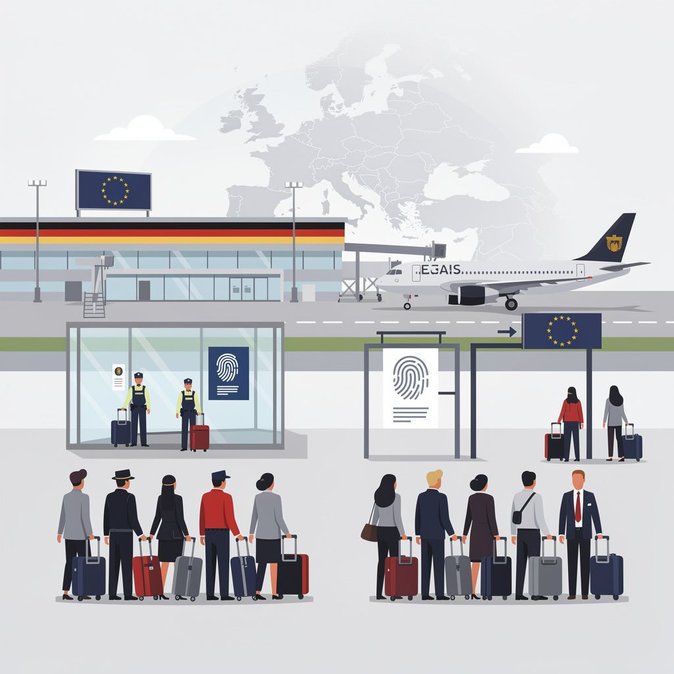
Germany has become the first EU member state to operationalise the new Common European Asylum System (GEAS) by opening a dedicated ‘external-border centre’ at Berlin-Brandenburg Airport (BER). Interior Minister Alexander Dobrindt (CSU) cut the ribbon on 14 June, only 48 hours after GEAS formally entered into force across the bloc. Housed in a fenced-off container complex next to the terminal, the facility can hold up to 40 people whose asylum claims are deemed manifestly unfounded or who are considered security risks. Applicants are treated as “not yet admitted” to German territory; their files are processed by Federal Police and onsite decision-makers from the Federal Office for Migration and Refugees (BAMF) within 12 weeks. Negative decisions trigger immediate removal via the next available flight, eliminating the need for costly transfers to inland detention centres. Dobrindt described the centre as a “milestone” that will let Germany “drive the GEAS locomotive instead of hitting the brakes”. He reiterated that the arrangement is not a prison but an expedited screening zone offering “bed, bread and soap”. Civil-society groups, however, criticised the use of barbed-wire fencing and 24/7 CCTV as a de-facto form of detention, warning of limited legal-aid access and mental-health risks for vulnerable travellers. For corporate mobility managers the message is clear: travellers from so-called safe countries who intend to claim asylum in Germany will be processed at the airport and, if unsuccessful, repatriated quickly. Carriers may therefore see fewer ‘non-admissible’ passengers entering the country, but they face tighter liability for return-flight costs when claims are rejected. Employers sponsoring skilled workers should ensure candidates arrive with the correct visa or Blue Card approval to avoid misunderstandings at the new facility. The ministry stressed that temporary internal border checks with neighbouring states will “continue for the foreseeable future” until GEAS proves its effectiveness, meaning business travellers should still plan for spot checks at land borders. Mobility teams are advised to monitor further roll-outs: four other German airports (FRA, MUC, HAM, DUS) are expected to receive similar centres by early 2027.
Source: BILD