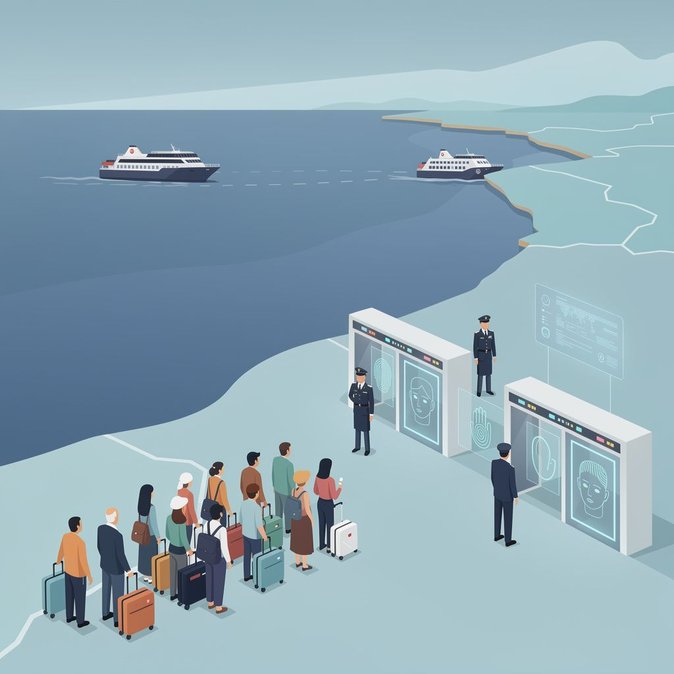
Spain on Monday launched the 2026 edition of Operación Paso del Estrecho (OPE), the annual summer exodus in which millions of Maghreb residents living in northern Europe drive through Spain’s ports on their way to Morocco and Algeria. From 15 June to 15 September, officials expect a record 3.5 million passengers and 850,000 vehicles to pass through Algeciras, Tarifa, Almería, Valencia and Algeciras ports. To cope with the surge, the government has rolled out the EU’s new Entry/Exit System (EES) biometric border checks at maritime and land crossings for the first time. Under the EES, third-country travellers must provide four fingerprints and a facial image that are stored for three years, replacing manual passport stamping.
For travellers who want peace of mind amid these new biometric requirements, VisaHQ offers step-by-step visa and entry guidance through its Spain portal (https://www.visahq.com/spain/). The platform lets individuals and corporate travel planners confirm documentation needs, complete applications online and track approvals in real time—making it easier to transit Spanish ports during OPE and beyond.
The Interior Ministry has installed 120 self-service kiosks and 65 manned e-gates at the main Andalusian ports and at the El Tarajal land border with Ceuta. Authorities say the technology will cut average control times from 45 seconds to 20 seconds once fully stabilised, although they warn of longer queues during the first days as travellers familiarise themselves with the process. Security has also been reinforced. Twenty-seven Frontex agents specialised in document fraud joined Spanish police this year, and the Directorate-General of Traffic has deployed real-time vehicle-tracking sensors on the A-7 and AP-4 motorways to predict congestion. The so-called “frontera inteligente” in Ceuta, fully operational for the first time, integrates plate recognition cameras, anti-ram bollards and an automated risk-analysis platform that flags overstayers. For companies with mobile workforces, the practical advice is to build extra time into itineraries, especially during the high-peak southbound phase (27 July-2 August) and the return northbound phase (27 August-1 September). Transporters carrying perishable goods must pre-book escorted convoys offered by the ports or risk missing ferry slots. Business travellers with biometric EU passports are unaffected, but UK nationals resident in Spain remain subject to EES capture on exit and re-entry. Spanish officials frame OPE 2026 as a dress rehearsal for the continent-wide launch of EES at airports this autumn. Lessons learned on the quay—such as the need for multilingual signage and mobile-first registration apps—will inform the roll-out at Madrid-Barajas and Barcelona-El Prat, where 200 e-gates are currently being installed.

For travellers who want peace of mind amid these new biometric requirements, VisaHQ offers step-by-step visa and entry guidance through its Spain portal (https://www.visahq.com/spain/). The platform lets individuals and corporate travel planners confirm documentation needs, complete applications online and track approvals in real time—making it easier to transit Spanish ports during OPE and beyond.
The Interior Ministry has installed 120 self-service kiosks and 65 manned e-gates at the main Andalusian ports and at the El Tarajal land border with Ceuta. Authorities say the technology will cut average control times from 45 seconds to 20 seconds once fully stabilised, although they warn of longer queues during the first days as travellers familiarise themselves with the process. Security has also been reinforced. Twenty-seven Frontex agents specialised in document fraud joined Spanish police this year, and the Directorate-General of Traffic has deployed real-time vehicle-tracking sensors on the A-7 and AP-4 motorways to predict congestion. The so-called “frontera inteligente” in Ceuta, fully operational for the first time, integrates plate recognition cameras, anti-ram bollards and an automated risk-analysis platform that flags overstayers. For companies with mobile workforces, the practical advice is to build extra time into itineraries, especially during the high-peak southbound phase (27 July-2 August) and the return northbound phase (27 August-1 September). Transporters carrying perishable goods must pre-book escorted convoys offered by the ports or risk missing ferry slots. Business travellers with biometric EU passports are unaffected, but UK nationals resident in Spain remain subject to EES capture on exit and re-entry. Spanish officials frame OPE 2026 as a dress rehearsal for the continent-wide launch of EES at airports this autumn. Lessons learned on the quay—such as the need for multilingual signage and mobile-first registration apps—will inform the roll-out at Madrid-Barajas and Barcelona-El Prat, where 200 e-gates are currently being installed.