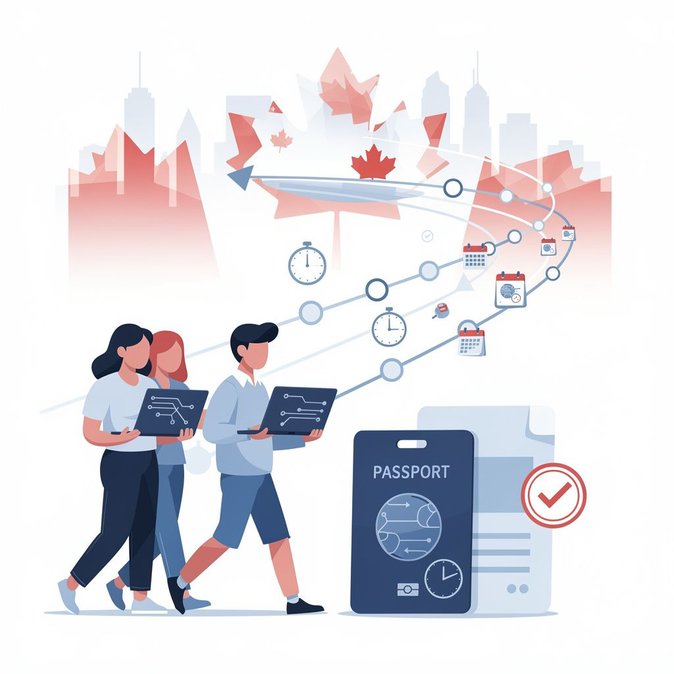
At 01:38 ET on June 16, immigration news outlet A2Z ImmiNews reported that IRCC has introduced a temporary measure allowing in-Canada Provincial Nominee Program (PNP) applicants and their spouses to apply for Bridging Open Work Permits (BOWPs) without waiting for an Acknowledgement of Receipt (AOR). Long processing backlogs meant many provincial nominees were losing work authorisation before their permanent-residence files were formally acknowledged.
For individuals and HR teams that prefer expert assistance when navigating these new IRCC rules, VisaHQ provides an intuitive online platform that walks users through document requirements, government fees and submission deadlines. Its dedicated Canada section (https://www.visahq.com/canada/) centralises the latest guidance on BOWPs, spousal open work permits and other Canadian immigration pathways, helping employers and applicants stay compliant with minimal effort.
Under the new policy, proof of electronic submission plus payment receipts will suffice. This change immediately benefits employers in fast-growing provinces such as Ontario, Alberta and Nova Scotia, where labour shortages persist in construction, healthcare and tech. For HR managers, the update reduces the risk of forced leaves of absence and payroll interruptions. Internal mobility programmes should revise checklists: candidates will still need medicals and biometrics, but the BOWP window now opens weeks—sometimes months—sooner. Spouses may also apply for open work permits, preserving dual-income household stability. IRCC says the measure is temporary pending a broader redesign of BOWP eligibility due later in 2026. Employers should track expiry dates carefully; once an AOR is issued, standard BOWP conditions (including validity tied to passport expiry) will apply. Immigration advisers recommend submitting BOWP applications within 24 hours of PR submission to minimise gaps. Companies with large PNP cohorts should update onboarding templates and inform payroll of potential SIN renewals triggered by new work-permit numbers.
For individuals and HR teams that prefer expert assistance when navigating these new IRCC rules, VisaHQ provides an intuitive online platform that walks users through document requirements, government fees and submission deadlines. Its dedicated Canada section (https://www.visahq.com/canada/) centralises the latest guidance on BOWPs, spousal open work permits and other Canadian immigration pathways, helping employers and applicants stay compliant with minimal effort.
Under the new policy, proof of electronic submission plus payment receipts will suffice. This change immediately benefits employers in fast-growing provinces such as Ontario, Alberta and Nova Scotia, where labour shortages persist in construction, healthcare and tech. For HR managers, the update reduces the risk of forced leaves of absence and payroll interruptions. Internal mobility programmes should revise checklists: candidates will still need medicals and biometrics, but the BOWP window now opens weeks—sometimes months—sooner. Spouses may also apply for open work permits, preserving dual-income household stability. IRCC says the measure is temporary pending a broader redesign of BOWP eligibility due later in 2026. Employers should track expiry dates carefully; once an AOR is issued, standard BOWP conditions (including validity tied to passport expiry) will apply. Immigration advisers recommend submitting BOWP applications within 24 hours of PR submission to minimise gaps. Companies with large PNP cohorts should update onboarding templates and inform payroll of potential SIN renewals triggered by new work-permit numbers.