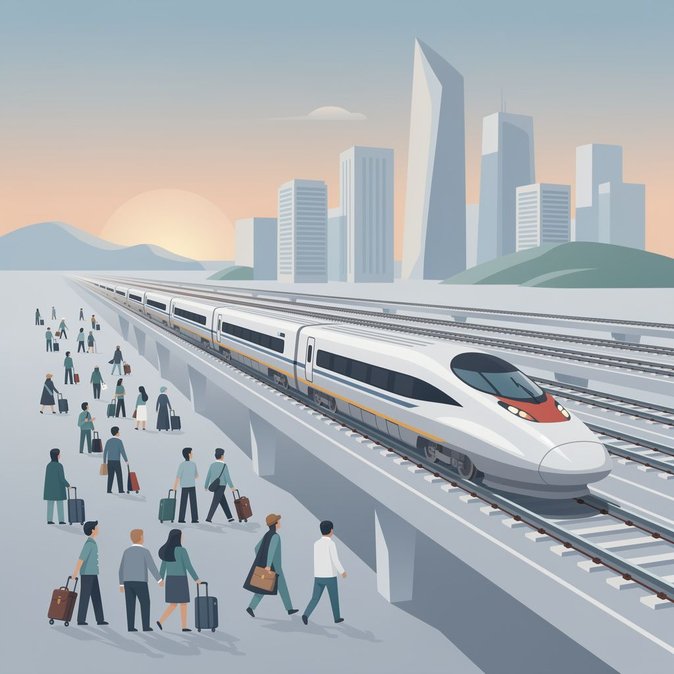
China State Railway Group (China Railway) pulled out all the stops on 19 June, scheduling 1,028 additional passenger services to absorb an expected 19.73 million journeys – the highest daily rail figure so far in 2026. Ticketing data from the 12306 app showed Beijing, Shanghai and Guangzhou as the top three departure cities, while Chengdu and Hangzhou led leisure destinations, underscoring the continuing “work-from-anywhere” trend among young professionals.
For international travelers who need the right paperwork to hop on these high-speed services, VisaHQ offers a quick online route to securing Chinese tourist or business visas, complete with real-time status updates and courier options; learn more at https://www.visahq.com/china/
To keep trains moving, the operator coupled multiple-unit sets on the busy Beijing–Shanghai high-speed artery and introduced overnight high-speed services on Guangzhou–Wuhan and Xi’an–Shanghai corridors. The company also trial-launched an AI-powered passenger-flow model that reallocates rolling-stock in 15-minute cycles based on real-time gate counts and WeChat location heat maps – technology that executives say will become permanent during the summer peak. For corporate mobility teams, the most practical change is seat availability: last-minute “G-class” (350 km/h) tickets were still on sale up to two hours before departure on many trunk routes, a rarity during Chinese public holidays. China Railway has hinted that the supplemental timetable could become a template for other peak-demand windows such as National Day. The surge also pressured station infrastructure. Beijing South handled 480,000 passengers – 16 percent above design capacity – yet maintained sub-eight-minute security-screening queues thanks to 40 temporary e-gates flown in from Shenyang. Similar pop-up checkpoints are expected at Chengdu East ahead of the autumn Canton Fair. Overall, the performance suggests that China Railway’s post-pandemic investment in flexible high-speed capacity is paying dividends, reducing the need for travellers to book flights on dense city pairs and offering multinational employers a lower-carbon alternative for intra-China trips.
For international travelers who need the right paperwork to hop on these high-speed services, VisaHQ offers a quick online route to securing Chinese tourist or business visas, complete with real-time status updates and courier options; learn more at https://www.visahq.com/china/
To keep trains moving, the operator coupled multiple-unit sets on the busy Beijing–Shanghai high-speed artery and introduced overnight high-speed services on Guangzhou–Wuhan and Xi’an–Shanghai corridors. The company also trial-launched an AI-powered passenger-flow model that reallocates rolling-stock in 15-minute cycles based on real-time gate counts and WeChat location heat maps – technology that executives say will become permanent during the summer peak. For corporate mobility teams, the most practical change is seat availability: last-minute “G-class” (350 km/h) tickets were still on sale up to two hours before departure on many trunk routes, a rarity during Chinese public holidays. China Railway has hinted that the supplemental timetable could become a template for other peak-demand windows such as National Day. The surge also pressured station infrastructure. Beijing South handled 480,000 passengers – 16 percent above design capacity – yet maintained sub-eight-minute security-screening queues thanks to 40 temporary e-gates flown in from Shenyang. Similar pop-up checkpoints are expected at Chengdu East ahead of the autumn Canton Fair. Overall, the performance suggests that China Railway’s post-pandemic investment in flexible high-speed capacity is paying dividends, reducing the need for travellers to book flights on dense city pairs and offering multinational employers a lower-carbon alternative for intra-China trips.