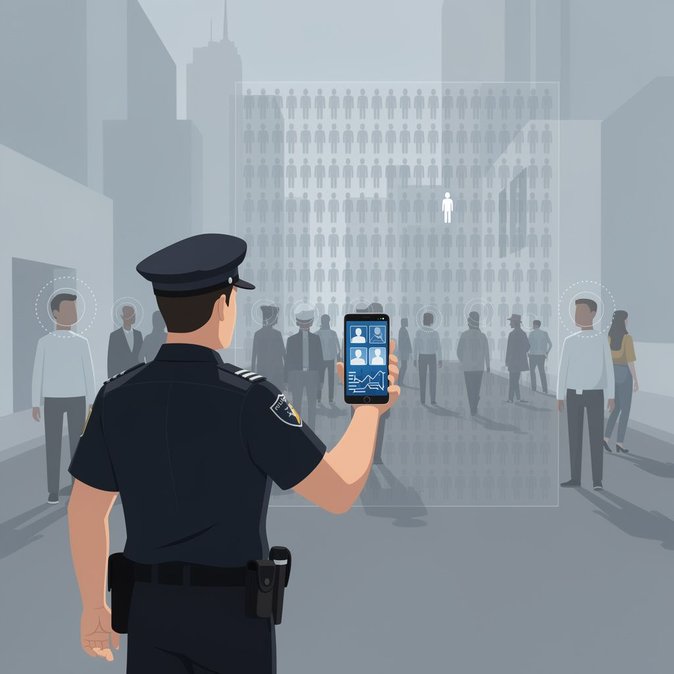
A newly uncovered Department of Homeland Security privacy filing confirms that Immigration and Customs Enforcement (ICE) quietly rolled out a mobile application called the “Task Force Module” (TFM) last September and has since begun sharing it with more than a thousand local law-enforcement agencies that partner with ICE under the 287(g) program. The app allows an officer to snap a photo of anyone they stop—during a traffic stop, protest, or ordinary street encounter—and instantly compare that image against more than 250 million federal records, including State-Department visa files and TSA’s Traveler Verification Service. If the system finds a match tied to an immigration violation, the phone instructs the officer either to detain the person or phone ICE for further guidance; if no match is found, it tells the officer to let the subject go. All photos are retained in a DHS database for 15 years. Civil-liberties advocates warn that the combination of broad police discretion and powerful face-matching could create what the Electronic Frontier Foundation calls a “papers-please dragnet,” chilling First-Amendment–protected activity and sweeping in U.S. citizens whose images are stored in travel and driver-license systems. The revelation comes as DHS Secretary Markwayne Mullin faces bipartisan questions in Congress about the department’s fast-growing use of face recognition. At a June 2026 oversight hearing he acknowledged the agency has already used facial recognition to identify protesters in Oregon and New Jersey. Privacy experts say extending that capability to local police multiplies the risk of misidentification—studies show higher error rates for darker-skinned faces—and of mission creep beyond immigration enforcement. ICE declined to provide details on training, audit logs, or accuracy testing, saying only that the tool “supports lawful immigration enforcement while respecting civil liberties.” For employers and global-mobility managers, the stakes are practical as well as philosophical. Companies that rely on international talent could see a rise in “street immigration checks” that lead to employee detentions—even for those with valid status—if local officers misuse the app or misread its results. HR teams may need to brief foreign staff on how to respond to facial scans, remind them to carry proof of status, and establish rapid-response protocols with counsel. The development also signals that data from visa applications, ESTA filings, and even routine TSA screenings can now funnel directly into local policing decisions. Practically, nothing in federal law obliges state or local agencies to accept ICE’s technology; some jurisdictions are expected to ban its use, citing civil-rights concerns. But in 287(g) “Task Force Model” counties—about 1,300 nationwide—deployment could be rapid. Mobility professionals should map employee footprints against those jurisdictions and monitor for policy changes. The episode underscores a broader trend: immigration enforcement tools are becoming more mobile, more algorithmic, and more deeply embedded in everyday policing, expanding the compliance terrain for businesses with internationally mobile workforces.
Source: NPR / WOSU Public Media