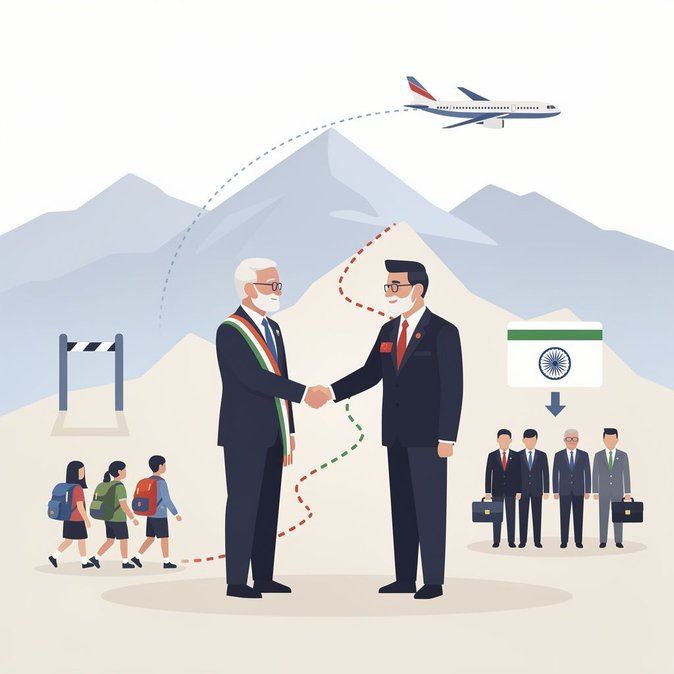
On the sidelines of the BRICS National Security Advisers’ conclave in New Delhi, Indian NSA Ajit Doval met Chinese Foreign Minister Wang Yi on 22 June for what both sides described as “constructive” talks. According to India’s Ministry of External Affairs, the discussion reviewed “recent developments in bilateral relations and noted progress towards gradual normalisation,” a coded reference to ongoing troop disengagement along the Line of Actual Control. From a global-mobility perspective, détente matters. Since 2020, Beijing and New Delhi have curtailed cross-border business travel: bilateral tourist visas dropped 94 %, and overland trade through Nathu La and Shipki La was effectively frozen. Industry groups such as the Confederation of Indian Industry estimate that the stand-off has cost Indian exporters US $2 billion in lost just-in-time supply contracts for electronics and pharma.
For travelers and corporate mobility planners seeking to capitalize on any forthcoming easing, VisaHQ’s India portal (https://www.visahq.com/india/) can streamline the paperwork the moment new visa channels reopen. The platform tracks regulatory updates in real time, pre-populates required forms for China and 200-plus other destinations, and offers concierge submission services—an advantage that can shave days off processing once mechanisms like the revived ‘Expedited M’ scheme or a future BRICS Business Traveller Card go live.
Although no immediate visa-liberalisation was announced, diplomatic sources indicate that both sides are considering a pilot reinstatement of the 2018 ‘Expedited M’ business-visa channel for companies operating in Special Economic Zones. The channel previously offered 48-hour consular turnaround for senior executives and allowed multiple entries up to one year. Travel-risk consultants advise multinational clients to monitor forthcoming joint statements: a phased reopening could begin with limited-quota visas tied to specific trade fairs such as the China-South Asia Expo in Kunming this August. Any relaxation would also ease logistics for the estimated 23,000 Indian students enrolled in Chinese medical universities who have faced repeated re-entry hurdles since the pandemic. The meeting further underscores India’s active BRICS chairmanship, which has prioritised smoother mobility among member states. Proposed deliverables under discussion include a common ‘BRICS Business Traveller Card’—a trusted-traveller document modelled on APEC’s ABTC—that could, if realised, significantly cut visa wait times for executives moving between the five economies.
For travelers and corporate mobility planners seeking to capitalize on any forthcoming easing, VisaHQ’s India portal (https://www.visahq.com/india/) can streamline the paperwork the moment new visa channels reopen. The platform tracks regulatory updates in real time, pre-populates required forms for China and 200-plus other destinations, and offers concierge submission services—an advantage that can shave days off processing once mechanisms like the revived ‘Expedited M’ scheme or a future BRICS Business Traveller Card go live.
Although no immediate visa-liberalisation was announced, diplomatic sources indicate that both sides are considering a pilot reinstatement of the 2018 ‘Expedited M’ business-visa channel for companies operating in Special Economic Zones. The channel previously offered 48-hour consular turnaround for senior executives and allowed multiple entries up to one year. Travel-risk consultants advise multinational clients to monitor forthcoming joint statements: a phased reopening could begin with limited-quota visas tied to specific trade fairs such as the China-South Asia Expo in Kunming this August. Any relaxation would also ease logistics for the estimated 23,000 Indian students enrolled in Chinese medical universities who have faced repeated re-entry hurdles since the pandemic. The meeting further underscores India’s active BRICS chairmanship, which has prioritised smoother mobility among member states. Proposed deliverables under discussion include a common ‘BRICS Business Traveller Card’—a trusted-traveller document modelled on APEC’s ABTC—that could, if realised, significantly cut visa wait times for executives moving between the five economies.