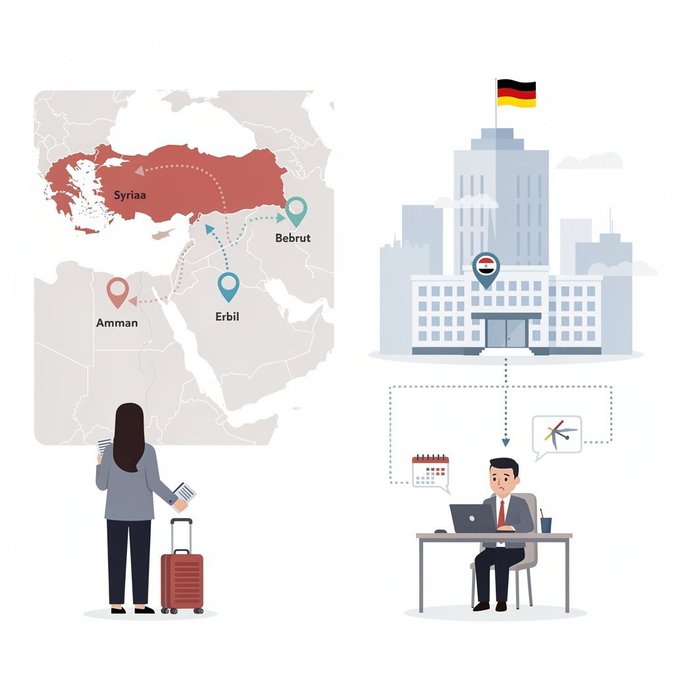
In a consular notice dated 23 June 2026, the German Federal Foreign Office announced that Syrian nationals residing in Syria must now submit both Schengen and long-stay visa applications through Germany’s embassies in Amman, Beirut or the consulate-general in Erbil. The change removes Damascus from Germany’s visa network and formalises a practice that had grown informally since the closure of the German embassy there in 2012. Applicants who had already secured appointments at other German missions before 31 May 2026 may keep them, but all new bookings must be made with the newly designated posts. The Cairo embassy notice emphasises that registrations cannot be transferred automatically; applicants must re-register and re-book under the correct mission and category.
For applicants and sponsoring employers who would like expert help navigating these new routing rules, VisaHQ can streamline the entire process. Through its digital platform (https://www.visahq.com/germany/), users can review mission-specific checklists, secure the earliest available appointment slots in Amman, Beirut or Erbil, and receive document pre-screening and courier support—reducing travel expenses and avoiding costly rejections.
For German employers recruiting Syrian talent—from healthcare workers to software developers—the rerouting means longer lead times and potentially higher travel costs for biometric appointments. Many companies have already begun to coordinate group appointments via relocation providers in Beirut to speed up onboarding. Human-rights NGOs caution that the requirement to travel to neighbouring countries may expose applicants to additional security risks and expenses. The Foreign Office counters that the three missions involved have expanded staffing and introduced TLScontact outsourcing to handle the caseload more efficiently. Businesses sponsoring Blue Card or Skilled-Worker visas should revise project timelines: current average appointment wait-times are six weeks in Beirut, eight in Amman and ten in Erbil. Employers are urged to budget extra for travel and accommodation reimbursements and to provide clear invitation letters to minimise document errors that could cause further delays.

For applicants and sponsoring employers who would like expert help navigating these new routing rules, VisaHQ can streamline the entire process. Through its digital platform (https://www.visahq.com/germany/), users can review mission-specific checklists, secure the earliest available appointment slots in Amman, Beirut or Erbil, and receive document pre-screening and courier support—reducing travel expenses and avoiding costly rejections.
For German employers recruiting Syrian talent—from healthcare workers to software developers—the rerouting means longer lead times and potentially higher travel costs for biometric appointments. Many companies have already begun to coordinate group appointments via relocation providers in Beirut to speed up onboarding. Human-rights NGOs caution that the requirement to travel to neighbouring countries may expose applicants to additional security risks and expenses. The Foreign Office counters that the three missions involved have expanded staffing and introduced TLScontact outsourcing to handle the caseload more efficiently. Businesses sponsoring Blue Card or Skilled-Worker visas should revise project timelines: current average appointment wait-times are six weeks in Beirut, eight in Amman and ten in Erbil. Employers are urged to budget extra for travel and accommodation reimbursements and to provide clear invitation letters to minimise document errors that could cause further delays.