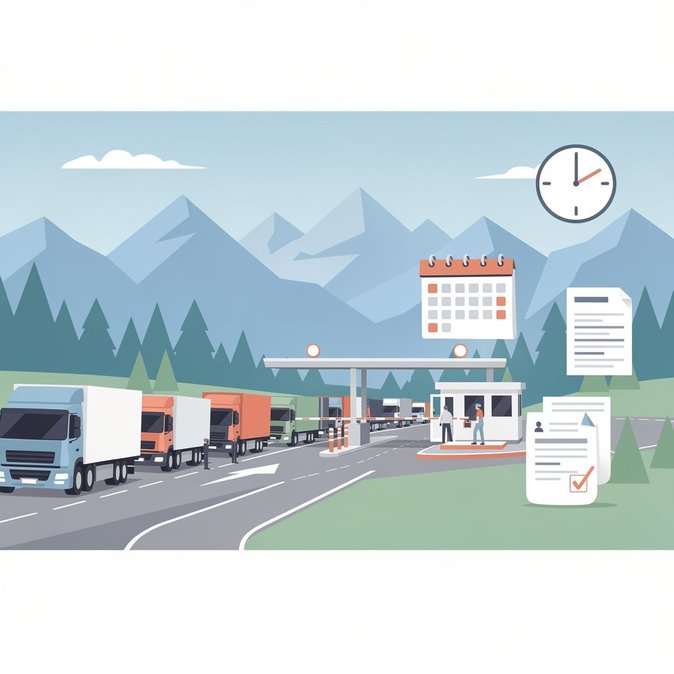
Live telemetry from the Austrian A10 shows renewed congestion around the 6.8-km Tauerntunnel, a crucial link between Salzburg and Carinthia, with delays topping 90 minutes during the early hours of 24 June. Reisereporter attributes the spike to overlapping school holidays in Bavaria, Croatia and parts of Italy, funnelling both leisure and commercial traffic onto the corridor. The A10 carries an estimated 60,000 vehicles per day in the summer season, far exceeding its design capacity. Unlike neighbouring alpine tunnels, the Tauern lacks a parallel rail alternative, making road users particularly vulnerable to accidents and maintenance closures.
Travelling across borders to reach or circumvent the Tauern can also require last-minute visa checks—particularly for mixed EU–non-EU crews. VisaHQ’s online platform (https://www.visahq.com/austria/) streamlines applications for Austrian and other Schengen visas, offering courier pickup and real-time status updates so drivers and passengers spend less time in consulate queues and more time on the road.
This week the ASFINAG maintenance division began night-time inspections of the northbound tube, requiring intermittent single-lane operation after 22:00—a schedule that will stretch until 5 July. Although conducted off-peak, any overrun into the morning rush risks compounding queues. For firms routing time-sensitive cargo from Eastern Europe to the Port of Trieste, the pinch point can jeopardise maritime cut-off times. Freight forwarders may want to detour via the Pyhrn corridor (A9) despite its own Bosruck toll, or pre-book slots on the Wörgl–Trento rolling-highway. Business travellers can consider flying Salzburg–Ljubljana and completing journeys by rail to avoid road uncertainty. ASFINAG recommends that private motorists with flexible schedules transit before 06:00 or after 20:00, make use of the digital Videomaut lane to bypass manual toll booths, and keep cash for the €13 one-way tunnel fee in case of scanner malfunction. Drivers of company cars should remember that a valid vignette is still mandatory for the entire A10 even if the Tauern toll has been prepaid. Further relief will come only when the long-planned third safety lay-by is completed in 2028, increasing emergency capacity and allowing smoother incident management.
Travelling across borders to reach or circumvent the Tauern can also require last-minute visa checks—particularly for mixed EU–non-EU crews. VisaHQ’s online platform (https://www.visahq.com/austria/) streamlines applications for Austrian and other Schengen visas, offering courier pickup and real-time status updates so drivers and passengers spend less time in consulate queues and more time on the road.
This week the ASFINAG maintenance division began night-time inspections of the northbound tube, requiring intermittent single-lane operation after 22:00—a schedule that will stretch until 5 July. Although conducted off-peak, any overrun into the morning rush risks compounding queues. For firms routing time-sensitive cargo from Eastern Europe to the Port of Trieste, the pinch point can jeopardise maritime cut-off times. Freight forwarders may want to detour via the Pyhrn corridor (A9) despite its own Bosruck toll, or pre-book slots on the Wörgl–Trento rolling-highway. Business travellers can consider flying Salzburg–Ljubljana and completing journeys by rail to avoid road uncertainty. ASFINAG recommends that private motorists with flexible schedules transit before 06:00 or after 20:00, make use of the digital Videomaut lane to bypass manual toll booths, and keep cash for the €13 one-way tunnel fee in case of scanner malfunction. Drivers of company cars should remember that a valid vignette is still mandatory for the entire A10 even if the Tauern toll has been prepaid. Further relief will come only when the long-planned third safety lay-by is completed in 2028, increasing emergency capacity and allowing smoother incident management.